What is X% of Y?
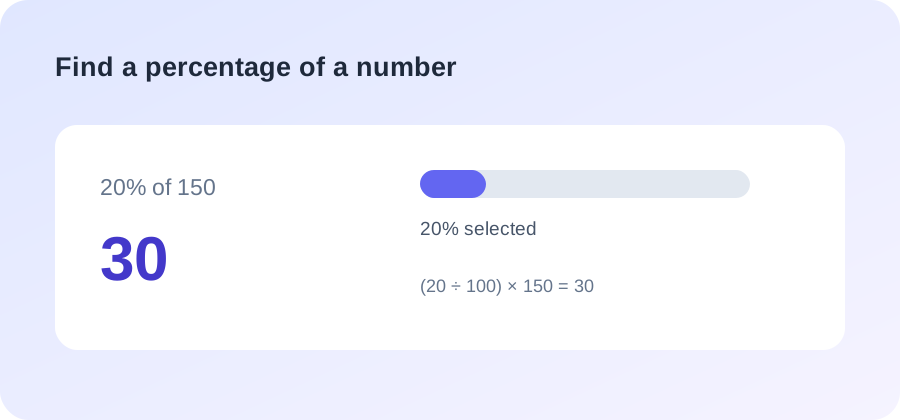
To find a percentage of a number, convert the percentage into a decimal by dividing it by 100, then multiply by the number. For example, 20% of 150 is 0.20 × 150 = 30.
Formula: (Percentage ÷ 100) × Number
Find a percentage of a number, calculate what percent one value is of another, increase or decrease a number by a percentage, and work out percentage change.
Find a percentage of any number.
Find what percentage one number represents of another.
Calculate a new value after applying a percentage increase or decrease.
Compare an original value with a new value to calculate the percentage increase or decrease.
Find the amount saved and the final price after a discount.
A percentage is a way of expressing a number as a fraction of 100. Percentages are used in shopping discounts, school mathematics, finance, statistics, business reports and everyday comparisons. This free percentage calculator helps you solve several common percentage problems in one place.
Choose the calculation that matches your question. You can find a percentage of a number, work out what percentage one value is of another, increase or decrease a value by a percentage, compare two values using percentage change, or calculate the final price after a discount.
For a complete equation that involves several mathematical steps, ask the AI maths problem solver to explain the working. If your calculation involves parts of a whole, use the fraction simplification and arithmetic tool; for powers, roots and trigonometric functions, open the scientific functions calculator.
To find a percentage of a number, convert the percentage into a decimal by dividing it by 100, then multiply by the number. For example, 20% of 150 is 0.20 × 150 = 30.
Formula: (Percentage ÷ 100) × Number
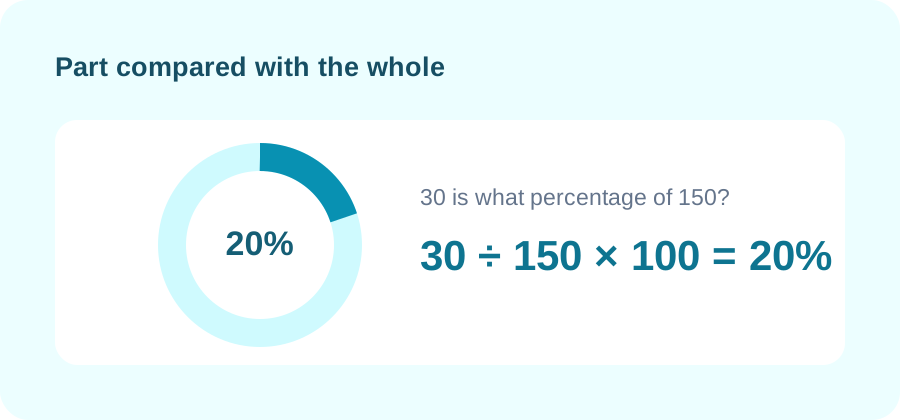
To find what percentage one value is of another, divide the part by the whole and multiply the result by 100. For example, 30 is 20% of 150.
Formula: (Part ÷ Whole) × 100
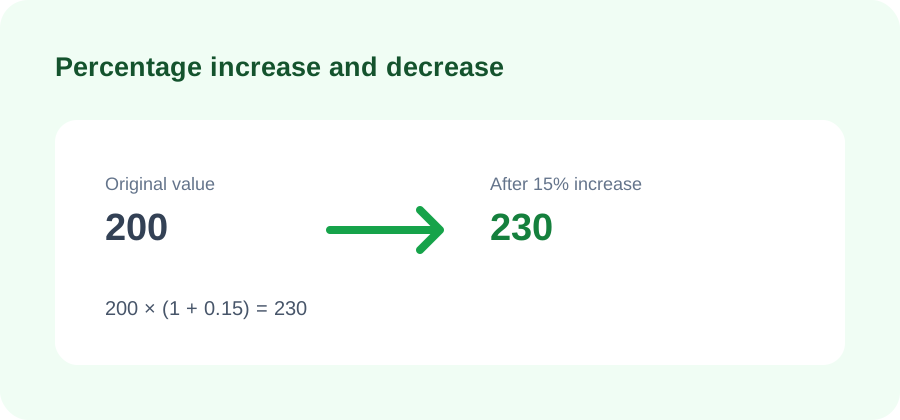
To increase a value by a percentage, calculate the percentage amount and add it to the original value. To decrease it, calculate the percentage amount and subtract it.
Increase: Original × (1 + Percentage ÷ 100)
Decrease: Original × (1 − Percentage ÷ 100)
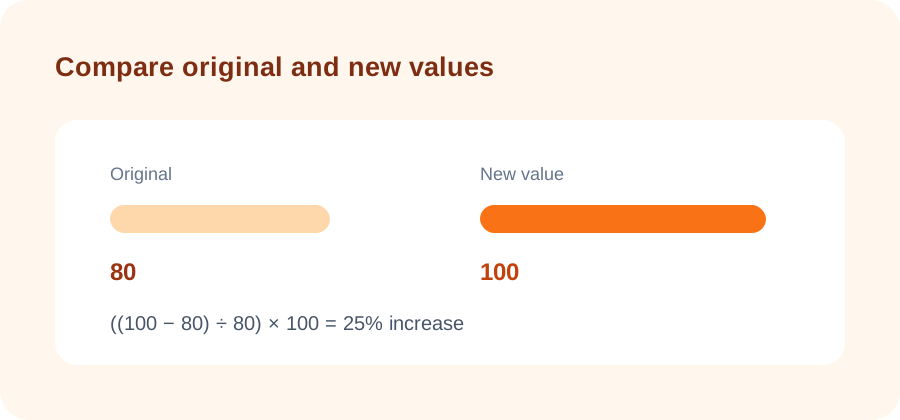
Percentage change compares a new value with an original value. A positive result indicates an increase, while a negative result indicates a decrease.
Formula: ((New − Original) ÷ Original) × 100
A discount is a reduction from an original price. Calculate the discount amount by multiplying the original price by the discount rate, then subtract the saving from the original price.
Final price: Original price × (1 − Discount ÷ 100)

Percentages help compare test scores, calculate sales tax, understand price reductions, measure business growth, interpret statistics and express proportions in a consistent format.
Convert 15% to 0.15. Multiply 0.15 by 80. The answer is 12.
Divide 45 by 60 and multiply by 100. The answer is 75%.
15% of 200 is 30. Add 30 to 200. The new value is 230.
25% of 100 is 25. Subtract 25 from 100. The new value is 75.
Divide the percentage by 100 and multiply the result by the number. For example, 10% of 50 is 0.10 × 50 = 5.
Divide the first number by the second number and multiply by 100. For example, 25 is 50% of 50.
Subtract the original value from the new value, divide the difference by the original value and multiply by 100.
Subtract the new value from the original value, divide that difference by the original value and multiply by 100. This gives the percentage decrease when the new value is lower.
Percentage change compares a new value with a designated original value. Percentage difference is commonly used to compare two values without treating either one as the starting value, often using their average as the reference.
Multiply the original price by the discount percentage divided by 100 to find the saving. Subtract the saving from the original price to get the final price.
Yes. A percentage greater than 100% means the amount is greater than the reference whole. For example, 150% of 40 is 60.
Yes. A negative percentage change means the new value is lower than the original value. A positive percentage change means the new value is higher.
Choose a calculation above, enter your values and get an instant result with the formula explained. Use the examples to practise percentage problems for school, shopping and everyday calculations.
Start calculating ↑Percentage questions often look similar but ask for different things. “What is 15% of 80?” asks for a part of a whole. “15 is what percent of 80?” asks for the rate. “What is the percentage increase from 80 to 92?” compares an old value with a new one. Select the matching calculator mode before entering your numbers.
A jacket costs 80 and has a 15% discount. Convert 15% to 0.15 and multiply it by 80 to find the saving: 12. Subtract the saving from the original price: 80 − 12 = 68. The discounted price is 68, before any additional taxes or fees.
Percentage change uses a starting value as its reference point, so it describes an increase or decrease from an earlier amount. Percentage difference compares two values without treating either one as the starting value. This distinction matters when comparing two test results, prices or measurements. For a direct comparison of proportional quantities, use the ratio calculator.
If a percentage is part of a fraction problem, the fraction calculator can help convert and simplify the values. For more involved formulas, use the scientific calculator, or ask the AI maths solver to explain the steps in a word problem.