1. Enter the two values
Type the first and second quantities. You can use positive whole numbers or decimals. Both values must be greater than zero for a standard ratio.
Simplify ratios, find equivalent proportions and divide totals into proportional shares with clear calculation steps.
Your calculations run in your browser. Values are not sent to a server.
This ratio calculator helps you simplify ratios, create equivalent ratios and divide a total into proportional shares. Enter two values to see their simplest whole-number relationship. You can also enter a total amount to calculate each share according to the ratio.
Ratios compare quantities and show how much of one value there is in relation to another. They are used in recipes, maps, scale drawings, classroom problems, mixtures, budgeting and many everyday situations where quantities need to stay in proportion.
When a ratio problem is part of a longer equation, you can follow the working with the AI maths explanation tool. This is useful when you need help understanding the steps rather than only checking the final proportion.
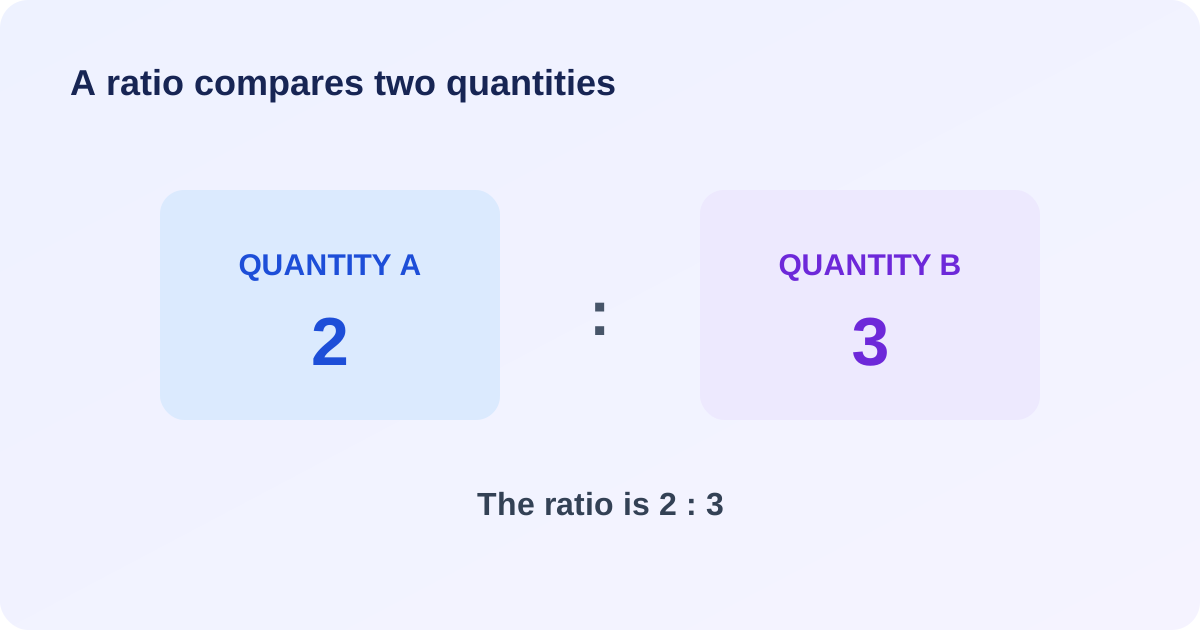
To simplify a whole-number ratio, divide both parts by their greatest common divisor (GCD). The relationship stays the same while the numbers become smaller.
Type the first and second quantities. You can use positive whole numbers or decimals. Both values must be greater than zero for a standard ratio.
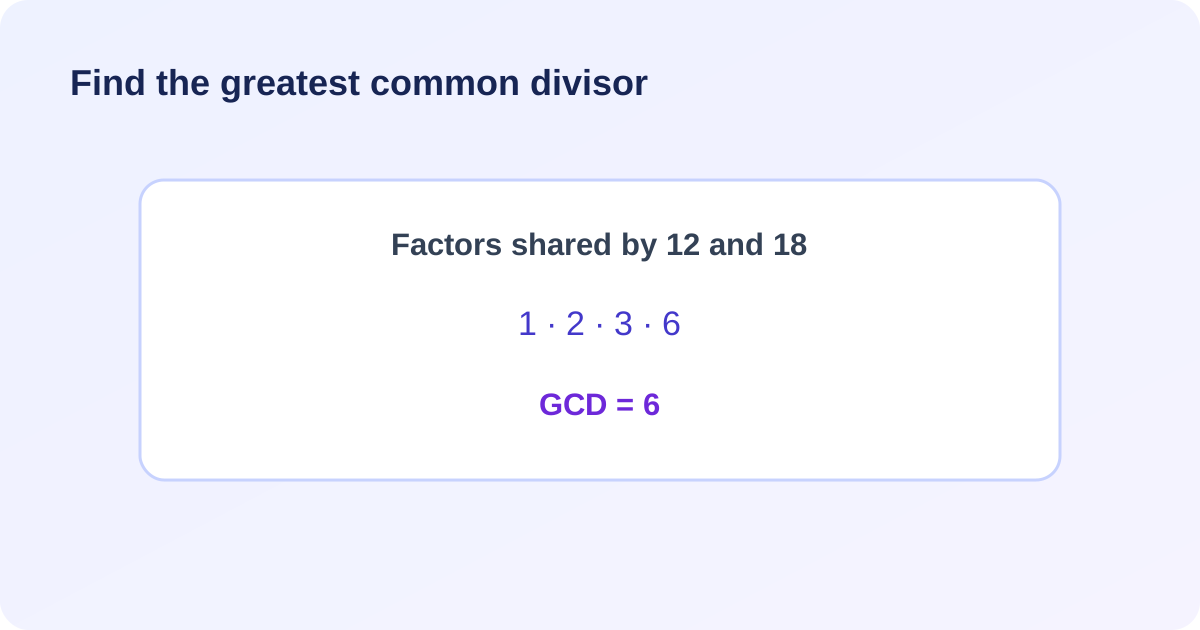
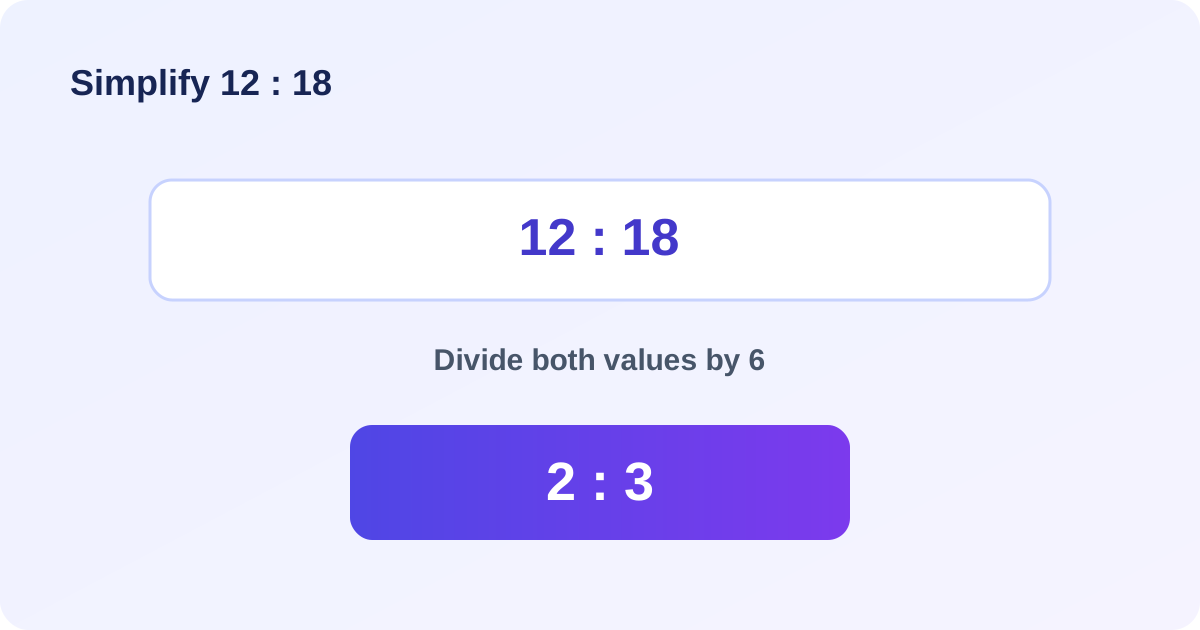
Find the greatest common divisor and divide both parts by it. For example, 12 : 18 becomes 2 : 3 after dividing each number by 6.
Equivalent ratios describe the same relationship using different numbers. Multiply or divide both parts by the same non-zero factor to create an equivalent ratio. For example, 2 : 3, 4 : 6 and 8 : 12 all express the same proportion.
If your ratio includes fractional quantities, the fraction arithmetic calculator can help you work with the underlying fractions.
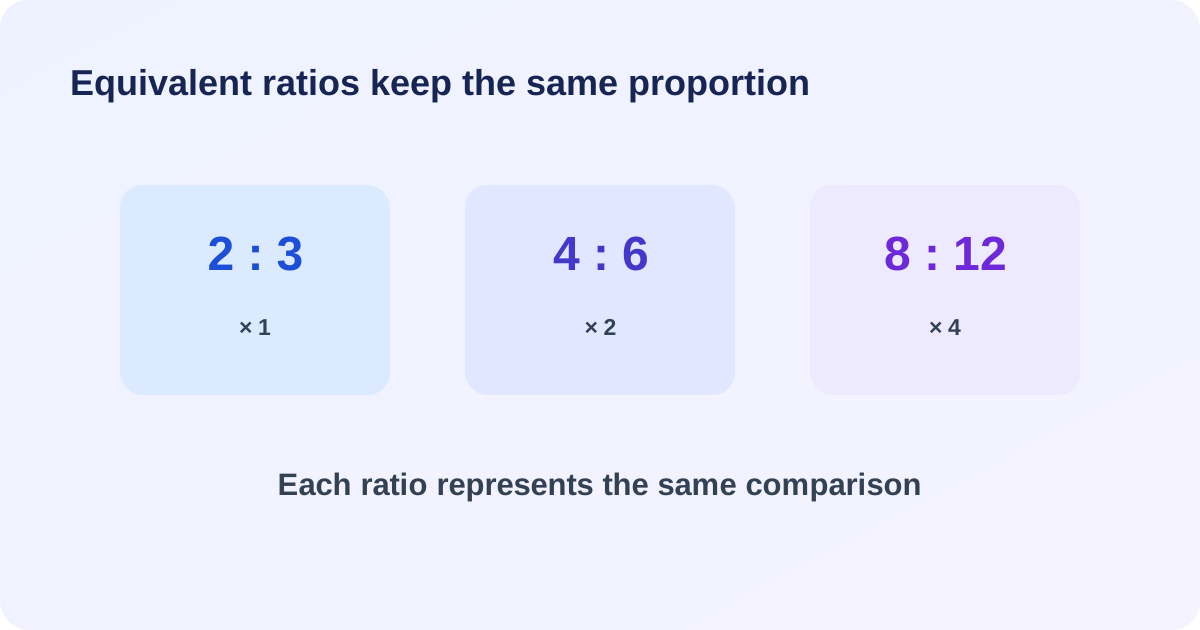
Choose a multiplier and apply it to both parts. A ratio of 2 : 3 multiplied by 4 becomes 8 : 12. The comparison remains unchanged because both values are scaled equally.
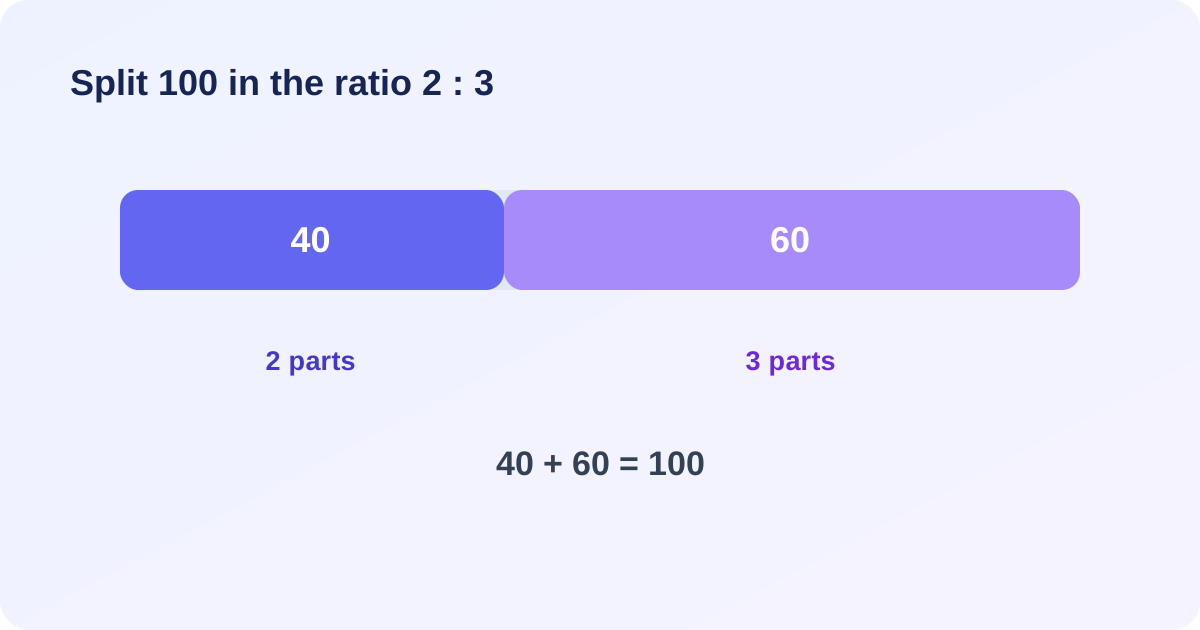
Add the ratio parts to find the total number of shares. Divide the amount by that total, then multiply by each ratio part. For example, dividing 100 in the ratio 2 : 3 gives 40 and 60.
A recipe may use 2 cups of one ingredient for every 3 cups of another. A budget can be split between two categories in a 2 : 3 relationship. A map scale also uses a ratio to compare distance on a drawing with real-world distance.
For percentage-based comparisons, use the percentage change and proportion calculator to express a difference as a percent.
Use another calculator when your problem involves a different kind of number operation.
Divide both parts of the ratio by their greatest common divisor. For example, 12 : 18 simplifies to 2 : 3 when both values are divided by 6.
Equivalent ratios show the same relationship. You can create one by multiplying or dividing both parts by the same non-zero number.
Add the ratio parts, divide the total amount by that sum, then multiply the result by each part of the ratio to find each share.
Yes. Enter positive decimal values. The calculator converts the relationship into a simplified whole-number ratio when possible.
No. The calculation runs locally in your browser. Your entered values are not sent to the website.
Enter two values above to find their simplest relationship, calculate an equivalent ratio and share a total proportionally.
Start calculating ↑A ratio compares quantities in a fixed relationship. In a recipe, a 2:3 ratio of rice to water means that for every two equal measures of rice, three equal measures of water are used. Scaling the recipe does not change the relationship: multiplying both parts by the same number produces an equivalent ratio.
Add the ratio parts: 2 + 3 = 5. Divide the total by five to find the value of one part: 90 ÷ 5 = 18. The first share is 2 × 18 = 36, and the second share is 3 × 18 = 54. Check the result by adding the shares: 36 + 54 = 90.
Two ratios are equivalent when both terms are multiplied or divided by the same non-zero factor. For example, 4:6 and 2:3 describe the same relationship because both terms in 4:6 can be divided by two. A ratio can be simplified in the same way as a fraction, so the fraction simplifier is useful when you want to see the shared factor.
When a question asks for a percentage of a total rather than a ratio, use the percentage calculator. For more complex numerical expressions, try the scientific calculator or the AI maths explanation tool.