1. Enter the numerators and denominators
Type the top and bottom numbers for each fraction. The denominator must not be zero. You can enter negative numerators as well as positive values.
Add, subtract, multiply, divide and simplify fractions. Get exact results, mixed numbers, decimal values and clear step-by-step working.
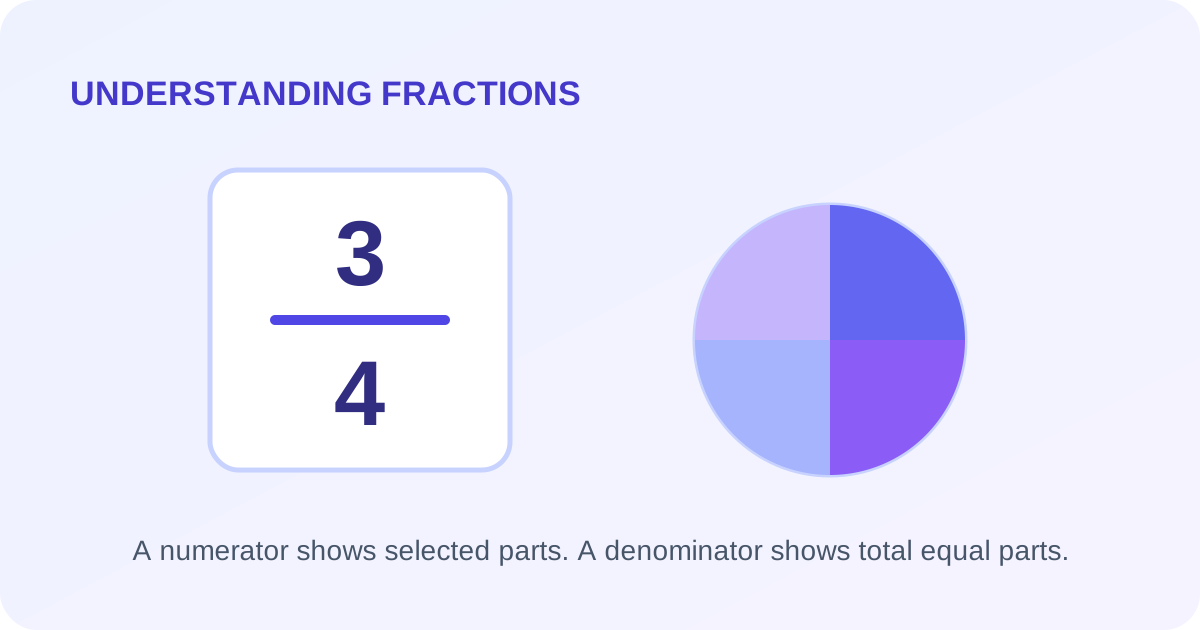
A fraction represents part of a whole and is written using two integers: a numerator on top and a denominator below. This free fraction calculator helps you work with common fraction operations without doing every calculation by hand. Enter the two fractions, choose an operation and calculate an exact result.
The calculator supports addition, subtraction, multiplication and division. It also reduces the final fraction to its simplest form and shows an equivalent mixed number when the answer is not a whole number. A decimal representation is included as an additional way to understand the value.
If you are working with a longer algebraic expression or need help understanding the method behind an equation, get guided working from the step-by-step AI maths assistant. For everyday number problems, calculate discounts and percentage changes with the percentage change and discount calculator, or handle powers, roots and trigonometry using the advanced scientific maths calculator.
Follow these simple steps to work out an operation between two fractions.
Type the top and bottom numbers for each fraction. The denominator must not be zero. You can enter negative numerators as well as positive values.
Select addition, subtraction, multiplication or division from the operation control. Use the example buttons if you want to load a sample calculation.
Select Calculate Fractions to display the exact answer in reduced form. The result area also shows the decimal equivalent and a mixed-number form when appropriate.
Read the steps to see how the numerators and denominators were combined. You can copy the result or print the answer, including saving it as a PDF from your browser's print window.
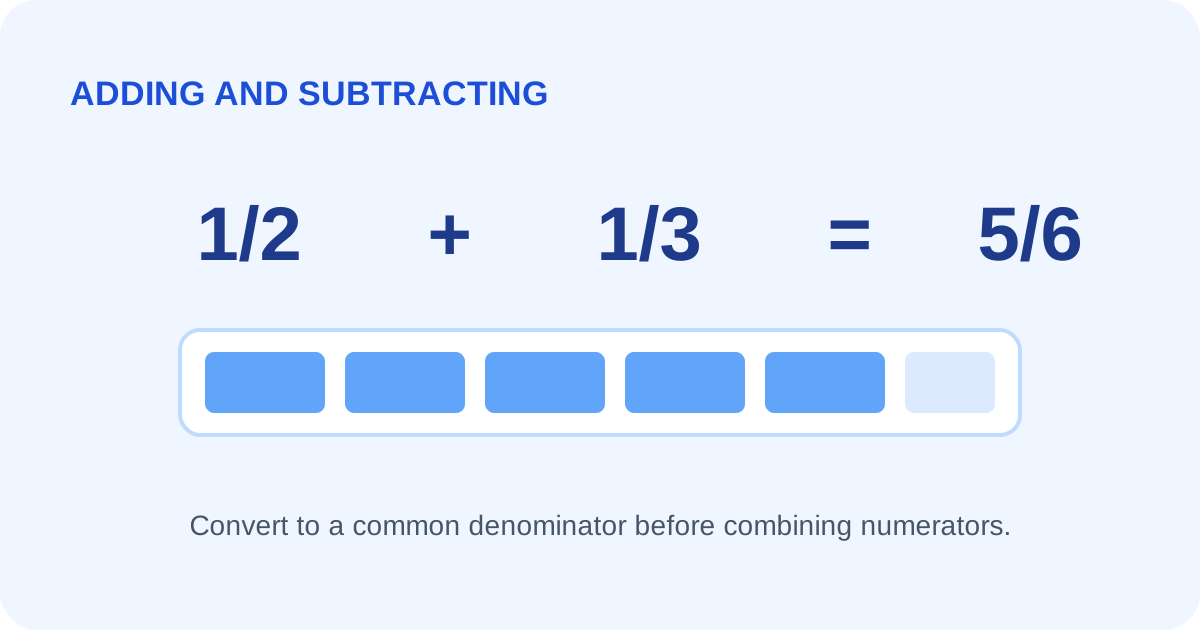
To add fractions with the same denominator, add their numerators and keep the denominator. When denominators differ, first find a common denominator, convert both fractions to equivalent fractions, and then add the new numerators.
For example, one-half plus one-third becomes three-sixths plus two-sixths, which equals five-sixths.
Subtraction follows the same denominator rule as addition. Convert fractions to a common denominator when needed, subtract the numerators and simplify the result by dividing the numerator and denominator by their greatest common divisor.
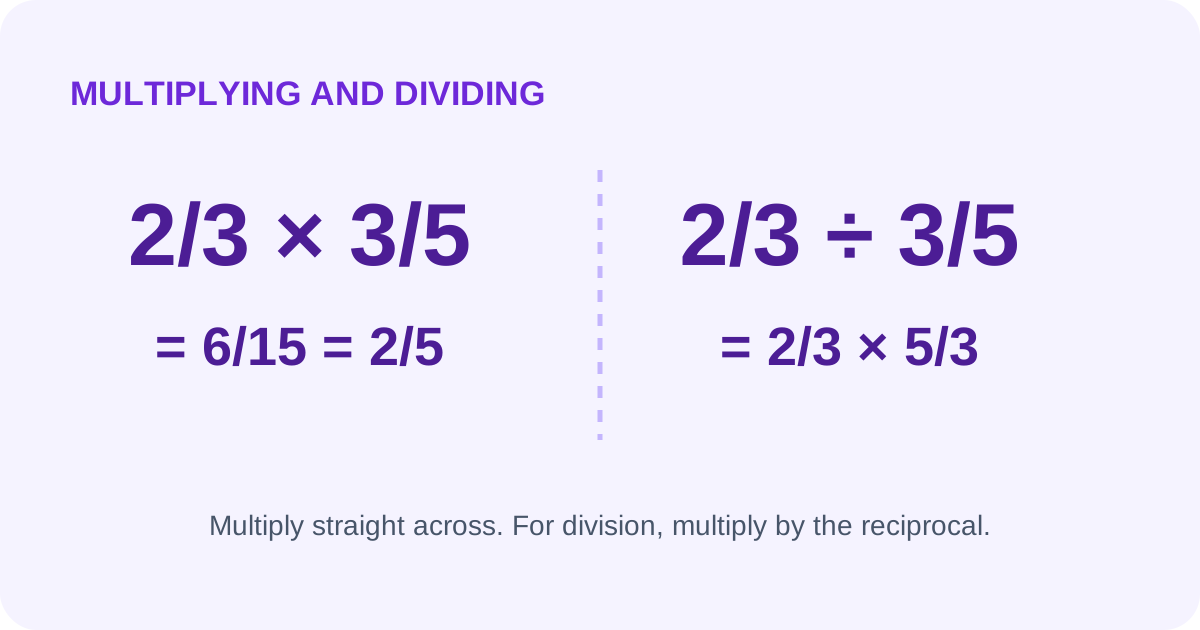
Multiply the numerator of the first fraction by the numerator of the second. Then multiply the denominators. Reduce the resulting fraction to its lowest terms.
For example, two-thirds multiplied by three-fifths gives six-fifteenths, which simplifies to two-fifths.
To divide by a fraction, multiply the first fraction by the reciprocal of the second fraction. The reciprocal is formed by swapping its numerator and denominator. Division by zero is not defined.
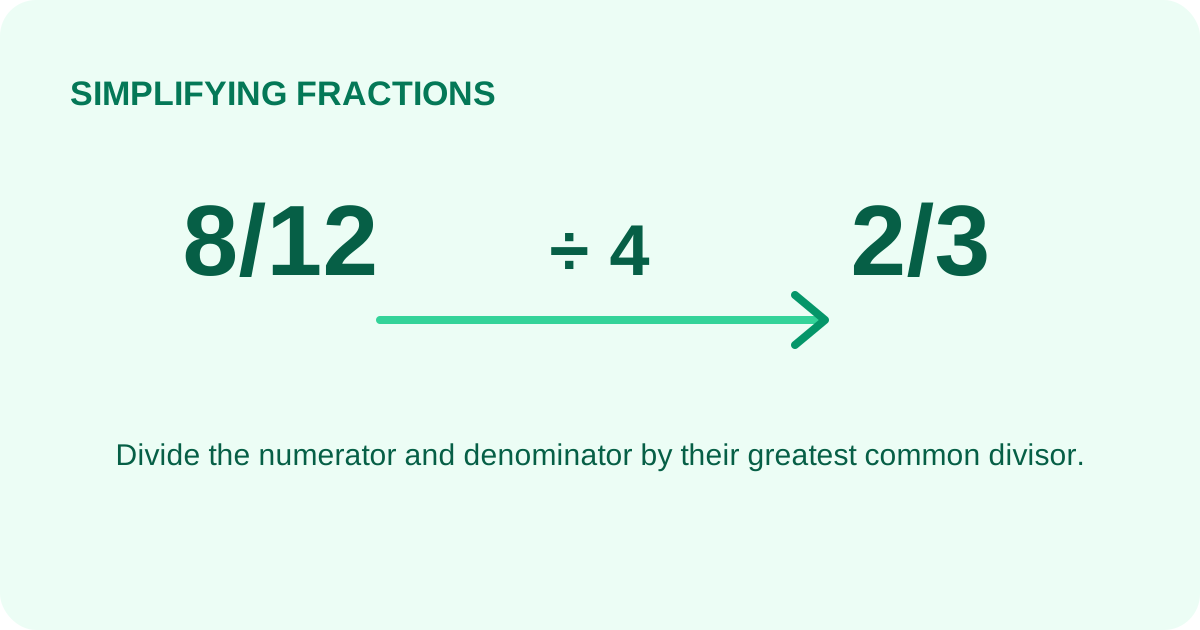
A fraction is in simplest form when its numerator and denominator have no common positive factor other than one. Find the greatest common divisor (GCD), then divide both parts by that number. For example, 8/12 simplifies to 2/3 because both 8 and 12 can be divided by 4.
An improper fraction has a numerator whose absolute value is greater than or equal to the denominator. It can represent a value greater than one or a whole number. For example, 7/4 is an improper fraction.
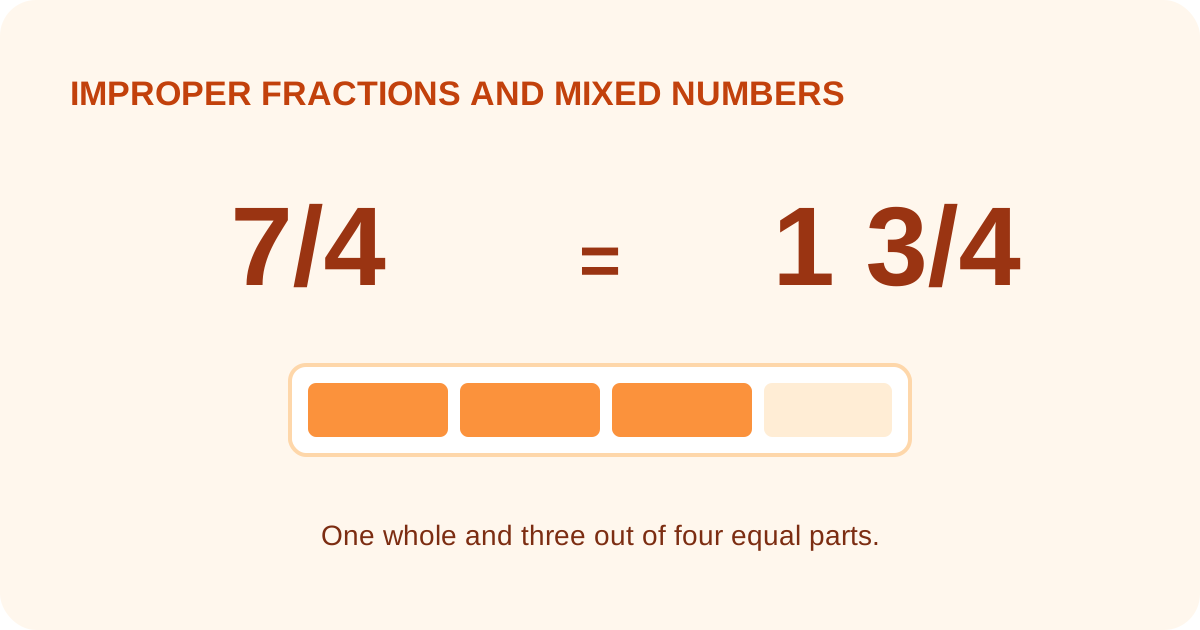
A mixed number combines a whole number with a proper fraction. The improper fraction 7/4 can be written as 1 3/4. The whole-number part is found by dividing the numerator by the denominator, with the remainder becoming the new numerator.
Equivalent fractions have the same value even though their numerators and denominators differ. Multiplying or dividing both parts by the same non-zero number creates an equivalent fraction, such as 1/2 and 2/4.
Continue practising with other mathematics resources on Tech Wave Cloud.
Enter the numerator and denominator for both fractions, choose an operation and select Calculate Fractions. The calculator displays the simplified answer, decimal value and working.
Yes. For addition and subtraction, the calculator finds a common denominator and converts both fractions before combining their numerators.
Divide the numerator and denominator by their greatest common divisor. This reduces the fraction without changing its value.
In a proper fraction, the numerator is smaller than the positive denominator. In an improper fraction, the numerator is greater than or equal to the denominator.
Yes. Divide the numerator by the denominator. The quotient is the whole-number part and the remainder becomes the numerator of the fractional part.
Yes, as long as the second fraction is not zero. Multiply the first fraction by the reciprocal of the second fraction.
Yes. It shows a decimal approximation alongside the exact fraction. The fraction remains the exact representation of the result.
Yes. Use Print / Save PDF in the result panel. In the browser print dialog, choose a printer or select Save as PDF.
Enter two fractions above to get an exact, simplified answer with clear working. Use the examples to practise each operation and build confidence with fraction calculations.
Start calculating ↑Start by checking what the question is asking. If two quantities are being combined, add the fractions. If one amount is being taken away from another, subtract. Multiplication is useful for finding a fraction of a quantity, while division answers how many times one fractional amount fits into another.
Consider 1/4 + 1/3. The denominators are different, so first use a common denominator. The smallest common denominator is 12. Convert the fractions to 3/12 and 4/12, then add the numerators: 3/12 + 4/12 = 7/12. The denominator stays 12 because the parts are now the same size.
A result such as 6/8 has the same value as 3/4, but 3/4 is easier to read and compare. Divide the numerator and denominator by their greatest common divisor to reduce a fraction. For calculations involving a decimal answer, use the percentage and decimal calculator to connect fractional values with percentages. If you need to check a longer numerical expression, the scientific calculation tool can handle powers and roots too.
For a word problem that combines fractions with an equation, the AI maths solver can help you inspect the reasoning step by step. For comparisons between two quantities, try the ratio calculator.