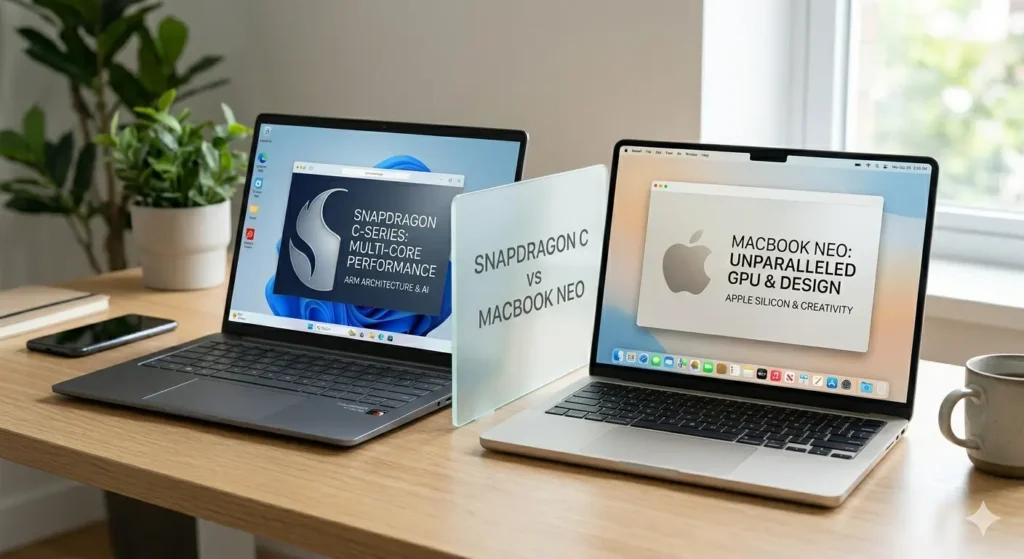
The Snapdragon C vs MacBook Neo discussion was inevitable the moment Qualcomm announced its new budget laptop processor.
Meanwhile, Apple has spent years proving that ARM chips can deliver:
- excellent battery life
- fast responsiveness
- cool operation
- thin laptop designs
Consequently, many consumers now associate ARM technology with premium computing experiences.
However, Qualcomm is approaching the market from a completely different direction.
Instead of targeting expensive laptops, the company wants to bring ARM-powered Windows devices to the $300 price range.
Because of that, Snapdragon C could become the first serious attempt to bring MacBook-style efficiency to budget Windows laptops.
This comparison also connects directly to:
- Snapdragon C: The $300 ARM Laptop Revolution
- Qualcomm Announces Snapdragon C for $300 Windows Laptops
- Qualcomm Finally Reveals a Budget-Friendly Windows on ARM Chip
Why the Snapdragon C vs MacBook Neo Comparison Matters
For years, Apple and Qualcomm largely competed in different markets.
Meanwhile, Apple’s laptops focused on:
- premium buyers
- creative professionals
- students with larger budgets
- ecosystem users
However, ARM technology has changed expectations across the entire industry.
Consequently, consumers increasingly expect:
- all-day battery life
- instant wake-up
- efficient performance
- quieter systems
from modern laptops.
Additionally, Qualcomm clearly wants Windows users to experience those same benefits.
Because of that, comparisons between Snapdragon-powered laptops and future budget MacBooks are unavoidable.
Both Platforms Rely on ARM Efficiency
One major similarity involves architecture.
Meanwhile, both companies use ARM technology to improve:
- efficiency
- battery life
- thermal performance
- portability
Consequently, both platforms prioritize user experience over raw power consumption.
Additionally, ARM processors often allow manufacturers to build:
- thinner laptops
- quieter systems
- cooler devices
- longer-lasting machines
Because of that, ARM continues gaining momentum throughout the laptop industry.
Furthermore, consumers increasingly appreciate battery life improvements more than small performance gains.
Qualcomm’s Biggest Advantage Is Price
While Apple focuses on premium products, Qualcomm is targeting affordability.
Meanwhile, many MacBooks remain outside the budget range of:
- students
- families
- first-time buyers
- educational institutions
Consequently, Qualcomm sees a major opportunity.
Additionally, laptops powered by the new chip could cost significantly less than Apple’s offerings.
Because of that, price may become Qualcomm’s strongest competitive weapon.
Furthermore, affordable ARM laptops could attract users who simply want:
- web browsing
- productivity tools
- streaming
- video calls
without paying premium prices.
Windows Offers Greater Flexibility
Another major difference involves software ecosystems.
Meanwhile, Windows remains the world’s most widely used desktop operating system.
Consequently, users gain access to:
- broader software compatibility
- gaming options
- enterprise applications
- specialized business tools
Additionally, many organizations already rely heavily on Windows infrastructure.
Because of that, switching to a Snapdragon-powered laptop may feel easier for many users than moving to macOS.
Furthermore, familiarity often influences purchasing decisions as much as hardware specifications.
Apple Still Holds Performance Advantages
To be fair, Apple currently maintains significant strengths.
Meanwhile, Apple’s ARM processors have established a reputation for:
- strong performance
- excellent efficiency
- software optimization
- premium experiences
Consequently, Qualcomm’s budget platform is not trying to beat Apple in every category.
Instead, the goal is different.
Additionally, Qualcomm focuses on:
- affordability
- accessibility
- battery life
- mainstream adoption
Because of that, the competition centers more on value than raw performance.
Battery Life Could Become a Major Battleground
Battery life remains one of the most important laptop features today.
Meanwhile, both companies emphasize efficiency.
Consequently, consumers may increasingly compare:
- endurance
- charging frequency
- portability
- real-world usage
rather than benchmark scores.
Additionally, long battery life benefits:
- students
- travelers
- remote workers
- office employees
Because of that, battery performance could heavily influence buying decisions.
For a complete overview of Qualcomm’s ARM strategy, read:
Snapdragon C: The $300 ARM Laptop Revolution
The Education Market Is Especially Important
Interestingly, education may become one of the most competitive areas.
Meanwhile, schools and universities often prioritize:
- affordability
- reliability
- battery life
- ease of management
Consequently, Qualcomm’s budget-first strategy could resonate strongly with educational buyers.
Additionally, many institutions already deploy:
- Windows devices
- Chromebooks
- hybrid learning systems
Because of that, affordable ARM-powered Windows laptops may find a receptive audience.
Furthermore, educational adoption often helps establish long-term ecosystem growth.
Qualcomm Wants to Expand Windows on ARM
Importantly, this launch is about more than a single processor.
Meanwhile, Windows on ARM continues growing steadily.
Consequently, lower-cost devices help bring the platform to more users.
Additionally, broader adoption encourages:
- developer support
- software optimization
- ecosystem growth
- hardware innovation
Because of that, Qualcomm’s long-term strategy may prove more important than immediate sales figures.
Consumers Ultimately Win
Competition generally benefits buyers.
Meanwhile, stronger competition often leads to:
- lower prices
- better battery life
- improved hardware
- faster innovation
Consequently, Apple’s success with ARM has helped push the entire industry forward.
Additionally, Qualcomm’s response may accelerate innovation even further.
Because of that, consumers gain more choices regardless of which platform they ultimately choose.
Final Thoughts
The Snapdragon C vs MacBook Neo comparison highlights a growing shift in the laptop industry.
Meanwhile, ARM processors are no longer limited to premium devices.
Consequently, Qualcomm is bringing efficient computing to a much larger audience.
Additionally, affordable ARM-powered Windows laptops could challenge traditional assumptions about budget computing.
For a broader look at Qualcomm’s plans, ecosystem strategy, and future ARM ambitions, see:
Snapdragon C: The $300 ARM Laptop Revolution
And surprisingly, the biggest winner in this competition may not be Qualcomm or Apple.
It may simply be consumers who finally gain access to better laptops at lower prices.