Getting your Oura Ring 5 sizing right is more important than picking the color or even deciding which subscription tier to pay for. Too tight, and the ring will bother you all day long. You will notice it every time you type, grip a steering wheel, or make a fist. Too loose, and the sensors won’t stay pressed against your skin. When that happens, your heart rate data becomes unreliable, your sleep staging gets noisy, and your HRV trends lose meaning.
Over the years, I have been through this with multiple Oura rings – the Ring 3, the Ring 4, and now the Ring 5. There was also one time I made the sizing mistake myself. Thinking back, I ordered a size too small because I tested the sample ring in the morning, when my fingers were at their smallest. By evening, that ring felt like it was cutting off circulation. I could not sleep with it. I could not wear it to the gym. It sat in a drawer for months before I finally sold it and bought the correct size.
Do not be that person.
This expanded guide covers everything you need to know about Oura Ring 5 sizing: how to use the free sizing kit, which finger works best, how to test the fit properly, what to do if you are between sizes, and how to avoid the most common mistakes that people make. By the end, you will order the right size the first time.
For a complete overview of the Ring 5’s specs, battery life, and subscription, check out our Oura Ring 5 launch guide.
Why You Absolutely Need the Free Sizing Kit
Oura includes a free sizing kit with every order. You pay a small deposit – usually around $10 – and Oura refunds that deposit when you confirm your ring size. Some people skip this step because they want their ring faster. That is a mistake.
Here is why Oura Ring 5 sizing is different from buying a regular ring at a jewelry store.
Reason 1: Oura Rings Are Thicker Than Normal Rings
A typical wedding band or fashion ring has a slim, rounded profile. The Oura ring houses multiple sensors, LEDs, batteries, and a circuit board. That makes it significantly thicker. A size 9 in a normal ring may feel comfortable, but the same size in an Oura ring could feel tight because the internal hardware takes up extra space.
Reason 2: Your Fingers Change Size Constantly
Most people do not realize how much their fingers swell and shrink throughout the day. In the morning, fingers are often at their smallest because you have been lying horizontally and fluids have distributed evenly. After a workout, after eating a salty meal, in hot weather, or at the end of the day, your fingers can swell by half a size or even a full size. If you size your ring based on how it feels at 8 AM, you will regret it by 8 PM.
Reason 3: The Ring Needs Skin Contact to Work Properly
The green and red LEDs on the inside of the ring need to sit flush against your skin. If the ring is too loose, it will slide around or spin. When that happens, the LEDs lose contact, and your heart rate data becomes spotty. Your sleep staging algorithm gets confused. Your HRV readings may show wild swings that do not reflect reality. In other words, a loose ring turns a $350 health device into an expensive bracelet.
Reason 4: You Cannot Easily Return a Wrong Size
Oura offers a 30‑day return window, but you have to pay for return shipping. Then you wait for the return to process. Then you order the correct size and wait for delivery again. That whole process can take three or four weeks. Meanwhile, your original ring sits in a box. The free sizing kit costs you a temporary deposit and maybe a week of patience. That is a small price to avoid weeks of hassle.
What Comes in the Sizing Kit?
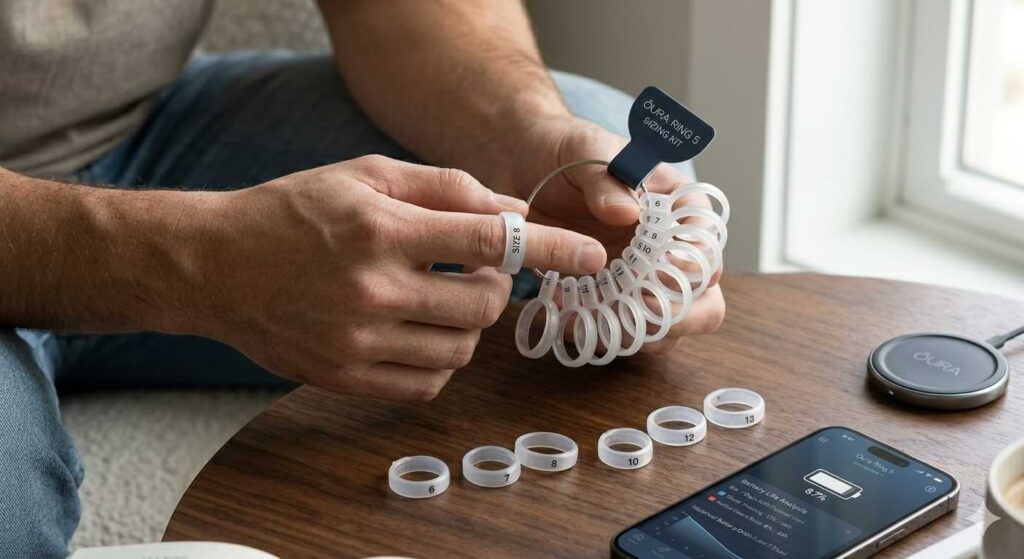
The Oura Ring 5 sizing kit is a small box containing plastic sample rings in sizes 6 through 13. These samples are not electronic. They do not track anything. They are simply physical models that match the exact dimensions – thickness, width, and interior shape – of the real Oura Ring 5.
Each sample ring has a number stamped on the inside. That number corresponds to the ring size. The samples are lightweight and smooth. They feel very close to the actual ring, though the real ring is slightly heavier because it contains electronics.
The kit also includes a printed card with basic instructions. Throw that card away and use the detailed process below instead.
How to Use the Sizing Kit Correctly
Most people put a sample ring on their finger for five seconds, decide it fits, and order that size. That is not nearly enough testing. Here is the correct process.
Step 1: Choose Your Starting Finger
Start with the index finger of your non‑dominant hand. If you are right‑handed, try your left index finger first. If you are left‑handed, try your right index finger first. Oura recommends the index finger because it provides the strongest blood flow signal and the most stable fit.
However, if you find the index finger uncomfortable when typing or gripping things, the middle finger is also excellent. The ring finger works but may shift more during sleep. Avoid the thumb and pinky.
Step 2: Try the Sample Ring On
Slide the sample ring onto your chosen finger. It should go on with a little resistance but not require painful force. Once on, it should feel snug but not cutting off circulation.
Push the ring toward your palm. Does it move easily? It should not. It should stay in place when you shake your hand.
Step 3: Wear It for 24 Hours
This is the most important step that almost everyone skips. Wear the sample ring for a full day and a full night. Do not just put it on for a minute.
Go about your normal routine. Type on a keyboard. Drive a car. Cook dinner. Lift weights or go for a run. Take a shower (the sample ring is waterproof). Sleep with it on.
Pay attention to how the ring feels during each activity. Does it dig into your adjacent fingers when you make a fist? What about spinning – does it twist around when you wash your hands? And how does it feel during the day compared to night – fine at noon but uncomfortably tight by bedtime?
Step 4: Check the Fit at Different Times
Your fingers change size throughout the day. Check the fit at three specific times:
- Morning (within 30 minutes of waking up). Your fingers are at their smallest. The ring should feel snug but not loose. If it feels loose in the morning, it will be too loose later.
- Mid‑afternoon. This is your normal baseline. The ring should feel comfortably snug.
- Evening (after dinner or after exercise). Your fingers are at their largest. The ring should feel snug but not painfully tight. If it hurts or leaves a deep indent, it is too small.
Step 5: Perform the Gap Test
Push the ring from underneath toward the tip of your finger. There should be a small visible gap – about 1 to 2 millimeters – between the base of the ring and the skin at the bottom of your finger. That gap indicates the ring is not too tight.
If there is no gap, the ring is too tight. If there is a large gap (4mm or more), the ring is too loose.
Step 6: Shake Your Hand
Shake your hand vigorously, like you are drying it off after washing. Does the ring spin or slide? A little rotation (maybe 10-20 degrees) is fine. Constant spinning or sliding down toward your knuckle means the ring is too loose.
Step 7: Make a Fist
Make a tight fist. Does the ring dig into the skin of your adjacent fingers? Does it feel like it is cutting in? If yes, try one size larger.
Step 8: Wear It While Sleeping
Sleeping is when the ring collects most of its data. If the ring is uncomfortable at night, you will take it off. And if you take it off, you lose sleep tracking entirely.
Wear the sample ring to bed. Do you notice it? Does it wake you up? Does it press against your other fingers when you curl your hand? For many people, the index finger feels fine during the day but bothersome at night. If that happens, try the middle finger.
Step 9: Compare Two Sizes
If you are unsure between two sizes – say, size 9 feels a little loose and size 10 feels a little tight – wear each sample for a full day. Often, the difference becomes obvious after a few hours of real use.
Do not trust your memory. Write down how each size feels at each time of day.
Which Finger Should You Wear the Oura Ring On?
This is one of the most common questions about Oura Ring 5 sizing. There is no single correct answer because everyone’s hands and preferences are different. However, there are clear pros and cons for each finger.
Index Finger (Recommended)
Pros: Strongest blood flow signal, most stable fit, least likely to spin, recommended by Oura themselves. The index finger tends to have a more consistent size throughout the day compared to other fingers.
Cons: Can feel bulky when typing on a keyboard. May get in the way when gripping a steering wheel, lifting weights, or using tools. Some people find it uncomfortable during sleep.
Best for: People who want the most accurate data and do not mind adjusting to the feel of a ring on their index finger.
Middle Finger
Pros: Almost as accurate as the index finger. Often more comfortable because the middle finger is less active in daily tasks. Many users find the middle finger to be the sweet spot between comfort and data quality.
Cons: The ring may shift slightly more than on the index finger. Some people have larger knuckles, making it hard to slide a properly fitting ring over the joint.
Best for: People who try the index finger and find it uncomfortable, especially during typing or sleep.
Ring Finger
Pros: Less noticeable for people who already wear a wedding band. The ring finger is often smaller, which can be good for people with very slender hands.
Cons: Data accuracy can be lower because the ring may shift more. If you already wear another ring on the same finger, the Oura ring can scratch it or feel crowded.
Best for: People who cannot comfortably wear the ring on their index or middle finger.
Thumb
Pros: None significant. The thumb is thicker, so sizing is different. Some people prefer the thumb for aesthetic reasons.
Cons: The thumb moves differently than fingers, which can affect data quality. The thumb also has a different blood flow pattern. Oura does not recommend the thumb.
Best for: No one. Stick with index or middle finger.
Pinky
Pros: Very small, so the ring is less noticeable.
Cons: Too small for reliable data. The pinky has weaker blood flow, and the ring may not stay in place. Avoid the pinky.
My advice: Start with the index finger of your non‑dominant hand. Wear it for a few days. If it feels awkward, switch to the middle finger of the same hand. Most people find a comfortable fit between those two.
Common Sizing Mistakes
I have seen people make the same mistakes over and over again. Avoid these.
Mistake 1: Sizing in the Morning Only
Your fingers are smallest in the morning. If you size based on morning fit, your ring will be too tight by evening. Always check the fit in the evening after a normal day of activity.
Mistake 2: Ignoring the Sensor Bumps
The inside of the Oura ring has small protrusions where the LEDs sit. Those bumps take up space. That is why the Oura ring feels tighter than a smooth metal ring of the same size. The sample rings have the same bumps, so the sample is accurate. But do not compare the Oura ring to your smooth wedding band.
Mistake 3: Assuming Your Ring Size Hasn’t Changed
If you have lost or gained weight, changed your exercise routine, or started a new medication, your finger size may have changed. Even if you knew your size for the Ring 4, check it again with the new sizing kit.
Mistake 4: Trying Only One Finger
Different fingers have different sizes. Your index finger might be a size 9, but your middle finger might be a size 8. Always try the ring on the finger where you plan to wear it. Do not assume the size is the same across all fingers.
Mistake 5: Forgetting About Seasonal Changes
In summer, your fingers swell from heat and humidity. In winter, they shrink. If you order a ring in December when your hands are cold and dry, that same ring may feel tight in July. Consider your local climate. If you live somewhere with hot summers, size up.
Mistake 6: Ordering Based on a Paper Sizer
Some people print a paper ring sizer from the internet. Those are not accurate. The thickness of the paper, the calibration of your printer, and the way you wrap the paper all introduce errors. Use the free plastic sizing kit that Oura provides.
What If You Are Between Sizes?
If one size feels slightly loose and the next size feels slightly tight, you have three options.
Option 1: Choose the Larger Size
This is almost always the right answer. Here is why:
- You can buy a silicone ring adjuster – a thin strip that goes inside the ring – to take up a little extra space. These cost a few dollars on Amazon.
- A slightly loose ring can still get good data. The sensors need contact, but they can tolerate a small amount of movement.
- A too‑tight ring will never become comfortable. You will stop wearing it.
- Your fingers will swell in summer, making a tight ring even tighter.
I have helped dozens of people with this decision. The ones who sized down almost always regretted it. The ones who sized up almost always found a way to make it work.
Option 2: Try a Different Finger
If size 10 feels loose on your index finger, try size 10 on your middle finger. Fingers are different sizes. You may find that the size that is between sizes on one finger fits perfectly on another.
Option 3: Wear the Sample for Another Day
Sometimes, the difference feels huge on first impression but becomes less noticeable after a few hours. Wear the larger sample for a full day. Then wear the smaller sample for a full day. Pay attention to how each feels at 3 PM and at 9 PM. The answer often becomes clear.
How to Use a Ring Adjuster
If you chose the larger size and still want a snugger fit, a ring adjuster is your friend.
Ring adjusters are small silicone strips or spiral bands that wrap around the bottom of the ring. They take up about half a size of space. They are inexpensive (around $5 for a pack of 10) and easy to remove.
How to apply: Slide the silicone strip into the inner groove of the ring. Trim any excess length. The adjuster should be invisible when worn.
Does it affect charging? No. The charger works through the adjuster.
Does it affect sensors? As long as the adjuster is on the bottom of the ring (the side opposite the sensors), it will not interfere with data collection.
Adjusters are a great temporary solution if you are between sizes or if you are losing weight and your ring becomes looser over time.
Sizing for Special Situations
If You Have Arthritis or Joint Swelling
Size up. A loose ring that you can actually wear is better than a perfectly fitted ring that hurts your joints. You can always use an adjuster to snug it up slightly. You cannot make a tight ring looser.
If You Are Buying as a Gift
Do not guess. Do not ask the person for their ring size (they will probably guess wrong). Instead, order the sizing kit and let the recipient try the samples themselves. It takes an extra week but saves a return headache.
If You Are Between Sizes 12 and 13
Oura sizes go up to 13. If you have thick fingers, order the size 13. The ring will not fall off. If it feels loose, use an adjuster.
If You Plan to Wear the Ring on Different Fingers
Some people switch fingers depending on the activity – index finger during the day, middle finger during sleep. That is fine, but you need to size for the smallest finger you plan to use. A ring that fits your index finger will be loose on your middle finger.
My Personal Sizing Story
I have owned four Oura rings. The first one – the Ring 3 – I sized correctly. First, I used the sizing kit. Then I wore the sample for two full days. After that, I ordered size 10. It was perfect.
For the Ring 4, I got cocky. I thought to myself, “I already know my size. I do not need the kit.” So I went ahead and ordered size 10 again. It arrived, and it felt fine in the morning. But by evening, my finger felt like it was in a vice. I could not sleep with it. I returned it, paid for shipping, waited three weeks, and ordered a size 11. That one was slightly loose, but I wore it with an adjuster for two years.
For the Ring 5, I used the sizing kit again. My fingers had changed slightly over the years. Size 10 now fit perfectly. But I would not have known that without the samples.
Learn from my mistake. Use the kit every time. Even if you owned a Ring 4, your fingers can change. Take the extra few days to be sure.
Frequently Asked Questions
How long does the sizing kit take to arrive?
Usually 3‑5 days within the US. International orders may take 7‑14 days.
Is the sizing kit really free?
You pay a refundable deposit, usually around $10. Oura refunds the deposit when you confirm your ring size.
Can I use my Ring 4 size for the Ring 5?
Yes, the sizing is identical between generations. If your Ring 4 fit perfectly, order the same size for the Ring 5.
What if my fingers are between sizes?
Choose the larger size. You can use a silicone ring adjuster to take up extra space.
Can I exchange the ring if I get the wrong size?
Yes, within 30 days. However, you pay for return shipping and wait for the return to process. Better to use the sizing kit first.
Does the Oura ring shrink or stretch over time?
No. The titanium shell does not change size. What changes is your finger – from temperature, activity, weight change, or aging.
Can I wear the ring on my toe?
Technically yes, but the data will be useless. The sensors are calibrated for fingers. Wear it on your hand.
How tight is too tight?
If the ring leaves a deep indent that does not fade within 10 minutes, if it hurts to make a fist, or if you cannot sleep with it – it is too tight.
Final Checklist Before You Order
Before you click that buy button, run through this checklist:
- I ordered the free sizing kit and wore the sample for at least 24 hours.
- I checked the fit in the morning, afternoon, and evening.
- I performed the gap test (1-2mm gap is ideal).
- I shook my hand to check for spinning.
- I made a fist to check for pinching.
- I wore the sample to sleep for one night.
- If between sizes, I chose the larger size.
- I ordered the ring using the size confirmed by my testing.
If you checked every box, congratulations. You will get the right size.
Bottom Line
Oura Ring 5 sizing is not difficult, but it requires patience. The free sizing kit exists for a reason. Use it. Wear the samples for a full day. Test the fit at different times. Choose the larger size if you are unsure.
A correctly sized Oura Ring 5 disappears on your finger. You forget you are wearing it. The data flows reliably. The battery lasts as advertised. And you never have to deal with the headache of a return.
Take an extra week to get it right. Your finger – and your sleep data – will thank you.
For everything else about the Oura Ring 5 – battery life, subscription, new features, and comparison with Ring 4 – read our full Oura Ring 5 launch guide.