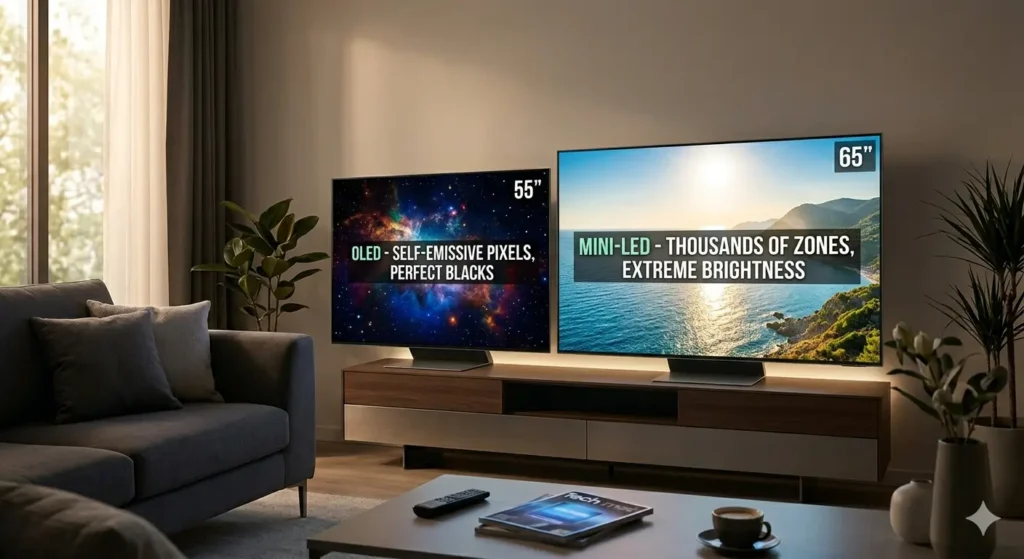
Shopping for a premium TV in 2026 usually comes down to one question: OLED or Mini-LED? Both technologies deliver impressive 4K picture quality, support modern gaming features, and now appear in TVs across multiple price ranges. However, they are designed differently, and each performs better in specific situations.
OLED TVs focus on perfect black levels, cinematic contrast, and ultra-fast response times. Meanwhile, Mini-LED TVs prioritize brightness, strong HDR highlights, and better value for large screen sizes. Because of that, the better choice depends less on marketing and more on your room lighting, viewing habits, and budget.
Some people mainly watch Netflix or movies late at night with the lights dimmed. Others keep sports running during the day in bright living rooms. Gamers may care more about response time, while families often just want the biggest screen possible for the best price.
This guide explains how OLED and Mini-LED work, compares their strengths and weaknesses, and helps you decide which TV technology fits your home best.
What Is OLED?
OLED stands for Organic Light Emitting Diode. Unlike traditional LED TVs, OLED panels do not use a separate backlight behind the screen. Instead, every individual pixel creates its own light.
That changes picture quality dramatically.
When an OLED TV needs to display black, those pixels simply switch off completely. The result is true black instead of the dark gray appearance many LED TVs still produce.
This is why OLED TVs look especially impressive during movies with dark scenes.
OLED Advantages
- Perfect black levels
- Infinite contrast ratio
- Wide viewing angles
- Extremely fast response times
- Thin premium design
- Excellent gaming performance
OLED Disadvantages
- Lower brightness than Mini-LED
- More expensive at larger sizes
- Small long-term burn-in risk
- Bright rooms reduce the contrast advantage
Modern OLED TVs are much brighter than older models, but Mini-LED still wins in raw brightness output.
What Is Mini-LED?
Mini-LED is an advanced version of traditional LED backlighting.
Instead of using a small number of large LEDs behind the display, Mini-LED TVs use thousands of tiny LEDs grouped into dimming zones. These zones brighten or darken independently depending on the scene.
As a result, Mini-LED TVs produce much better contrast than standard LED TVs.
They still cannot completely match OLED black levels, but the difference is far smaller than it used to be.
Mini-LED Advantages
- Much brighter HDR performance
- Better for sunny rooms
- No burn-in concerns
- Usually cheaper than OLED
- Excellent value for large TVs
Mini-LED Disadvantages
- Blooming around bright objects
- Blacks are not truly perfect
- Viewing angles are weaker
- Motion response is slightly slower
Cheaper Mini-LED TVs also vary significantly in quality. Budget models with fewer dimming zones often show more noticeable blooming during dark scenes.
OLED vs Mini-LED Picture Quality
This is where OLED usually takes the lead.
Dark scenes simply look cleaner on OLED because there is no backlight glow behind black areas. Space scenes, horror movies, and nighttime cinematography benefit the most from this technology.
Mini-LED TVs still look excellent, especially high-end models from Samsung, TCL, and Hisense. However, bright objects on dark backgrounds can sometimes create a halo effect called blooming.
Some viewers barely notice it. Others notice it immediately.
At the same time, Mini-LED brightness can look extremely impressive with HDR content. Sunlight, explosions, reflections, and sports broadcasts often appear more intense than they do on OLED.
So the “better” picture quality depends partly on your environment and viewing preferences.
Which Technology Is Better for Bright Rooms?
Mini-LED clearly wins here.
Bright rooms reduce OLED’s biggest advantage because sunlight and reflections make deep black levels harder to appreciate. A strong Mini-LED TV can push through glare much more effectively.
If your TV sits near windows or you mostly watch during daytime hours, Mini-LED usually feels more practical.
This is one reason many sports fans prefer it.
Which Is Better for Movies?
For movie lovers, OLED still feels more cinematic overall.
The contrast looks cleaner, shadow detail appears deeper, and dark scenes gain a sense of depth that LED-based TVs still struggle to fully match.
Watching movies in a dim room on a good OLED TV genuinely feels premium.
Sony and LG OLED models are especially strong for cinema-style viewing.
That said, high-end Mini-LED TVs narrowed the gap significantly over the past few years.
OLED vs Mini-LED for Gaming
Gaming performance is excellent on both technologies now.
OLED still has the edge in response time because pixel transitions happen almost instantly. Motion clarity feels incredibly smooth, especially in fast shooters or racing games.
Many OLED TVs also support:
- HDMI 2.1
- VRR
- 120Hz refresh rates
- low input lag
Mini-LED gaming TVs improved massively too. HDR games often look brighter and more vibrant, especially in bright rooms.
However, some gamers still worry about OLED burn-in from static HUD elements like health bars or minimaps.
For most players, burn-in is unlikely with normal mixed usage. Still, people who play the same game constantly for years may feel safer with Mini-LED.
Is OLED Burn-In Still a Real Problem?
Not for most people.
Older OLED TVs had a worse reputation for burn-in. Modern models now include:
- pixel shifting
- logo dimming
- automatic panel refresh systems
- brightness protection features
Because of that, permanent burn-in is fairly rare under normal use.
Still, it can happen eventually if someone:
- watches the same news channel all day
- leaves static menus on screen constantly
- plays one game with fixed HUD elements for years
Mini-LED avoids this issue completely.
Which Technology Makes More Sense for Large TVs?
Mini-LED usually offers better value once screen sizes become very large.
A 75-inch or 85-inch OLED still costs significantly more than a comparable Mini-LED TV. Meanwhile, large Mini-LED TVs became much more affordable in recent years.
For families wanting the biggest screen possible without spending several thousand dollars, Mini-LED often makes more sense financially.
TCL and Hisense especially pushed aggressive pricing in this category.
Which One Should You Actually Buy?
At this point, OLED vs Mini-LED is less about which technology is “better” and more about which one fits your room and viewing habits.
Choose OLED If:
- You mostly watch movies at night in a dim or dark room.
- Deep blacks and cinematic contrast matter more than raw brightness.
- You want ultra-fast response times for gaming.
- You don’t mind paying extra for premium picture quality.
- Your room can be darkened easily.
OLED is fantastic for home theater enthusiasts and anyone who values that special cinematic look. Once you experience true black, it’s hard to go back.
Choose Mini-LED If:
- Your living room gets a lot of daylight or has bright windows.
- You watch sports during the afternoon or daytime TV regularly.
- You want the biggest screen possible for your budget (75 inches or more).
- Burn-in concerns bother you, even if the risk is small.
- You prefer punchy HDR brightness over perfect black levels.
Mini-LED is the smart, practical choice for most families. It handles real‑world conditions better and gives you more screen size for your money.
Neither option is bad anymore. Both technologies look excellent in 2026. The best choice is the one that matches how you actually watch TV every day.
Final Thoughts
The OLED vs Mini-LED debate no longer has a single universal winner. OLED still delivers the most cinematic picture quality overall, especially for movies and dark‑room viewing. Mini-LED, however, became incredibly competitive thanks to its brightness, lower prices, and improved contrast performance.
For many households, Mini-LED is honestly the smarter practical choice. For movie enthusiasts and people who care deeply about image quality, OLED still feels special in a way that LED-based TVs rarely match.
The best option is the one that fits your room, your habits, and your budget — not simply the most expensive TV on the shelf.
For current pricing and the best available TV deals, check out our best TV deals 2026 guide.