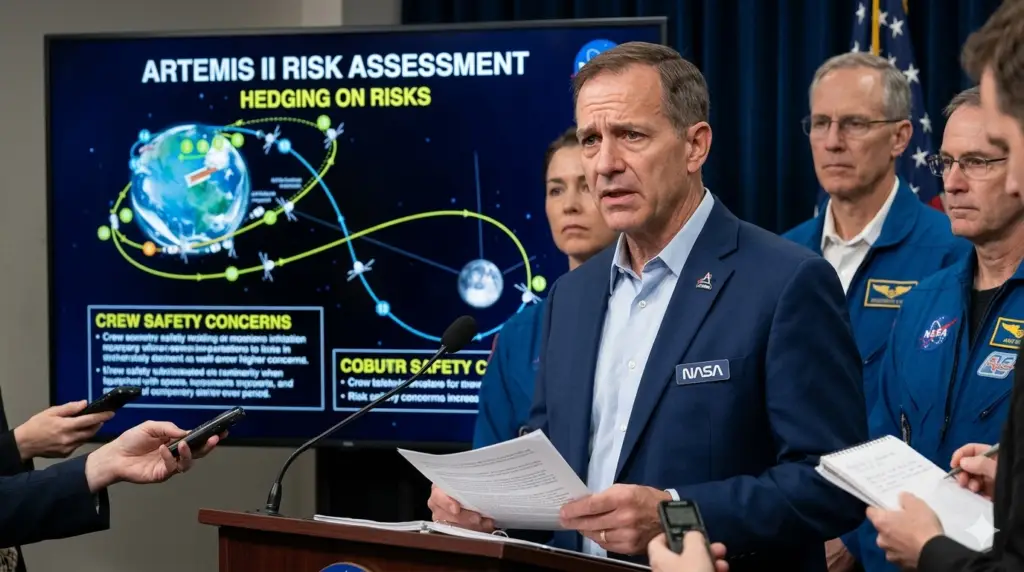
When talking about risk during a press conference on Thursday, the NASA officials in charge of the upcoming Artemis II Moon mission hedged their answers. With just a single data point from flight testing—the unpiloted Artemis I demo mission in 2022—NASA managers were reluctant to publicize the bottom-line number from their probabilistic risk assessment .
Quick Overview
| Detail | Information |
|---|---|
| Mission | Artemis II |
| Crew | 4 astronauts |
| Duration | 9 days |
| Destination | Several thousand miles beyond far side of the Moon |
| Launch Window | No earlier than April 1, 2026, 6:24 pm EDT |
| Backup Dates | April 2 added; more opportunities late April |
| Key Hardware | SLS Rocket + Orion Spacecraft (2nd flight together) |
| Primary Risk Factors | MMOD, environmental control/life support, ascent burns |
The Challenge of Quantifying Risk
Why NASA Won’t Give a Number
Lori Glaze, NASA’s acting associate administrator for exploration system development, said the agency completed an assessment for Artemis II but questioned the exercise’s usefulness:
“I think sometimes we get tricked into believing that those numbers are somehow really telling us something critically important. I think they’re valuable. I think we can do things in a relative sense to measure what’s more risky or less risky.”
The Statistical Reality
John Honeycutt, chair of the Artemis II mission management team, offered an uncharacteristically blunt assessment:
- About half of all rockets fail on their first flights (50-60% success rate globally)
- SLS performed marvelously on Artemis I
- For Artemis II: “It’s probably not 1 in 50… but it’s probably closer to 1 in 2”
He explained: “I think we’re being really careful not to really lay probabilistic numbers on the table for this mission, just given the small amount of data.”
Historical Context: Past Risk Assessments
| Mission | Assessed Risk (Loss of Crew) | Reality |
|---|---|---|
| First Shuttle (1981) | 1-in-500 to 1-in-5,000 | Actually 1-in-10 to 1-in-12 |
| Apollo missions | ~1-in-10 | Successful (after Apollo 1) |
| Shuttle program average | ~1-in-90 (post-disaster) | Two fatal missions |
| Crew Dragon (2020) | 1-in-276 | Successful |
| Starliner (2024) | 1-in-295 | Successful |
Honeycutt cited the danger of falling foam on the space shuttle—which led to Columbia’s destruction—as an example of how complex risk chains can be underestimated .
What Is Actually Being Assessed
Top Risks for Artemis II
Matt Ramsey, Artemis II mission manager, identified:
- Micrometeoroids and orbital debris (MMOD) – collisions with tiny particles
- Environmental control and life support system – didn’t fly with full capability on Artemis I
However, Honeycutt has a different perspective:
“When we’ve got the most dynamic activities going on, like during ascent, when we’re doing those burns, doing the perigee raise, and then we’re doing the TLI (Trans-Lunar Injection) burn, those are going to be the times that we’re introducing the most risk into the whole mission.”
The Launch Abort System
Unlike the space shuttle, SLS and Orion have a Launch Abort System giving astronauts the ability to escape during ascent. Ramsey noted: “That mitigates a lot of the ascent risk.”
The Crew’s Perspective
Commander Reid Wiseman spoke candidly about preparing his family:
“I went on a walk with my kids, and I told them, ‘Here’s where the will is, here’s where the trust documents are, and if anything happens to me, here’s what’s going to happen to you.’ That is a part of this life.”
Despite the unknowns, Wiseman is ready:
“For me, I actually feel completely 100 percent bought in. When I get into Orion, it’s like climbing into my bed, and I’ll feel warm and tucked in.”
The Path Forward
Recent Technical Issues
The Artemis II launch was originally scheduled for February but delayed due to:
- Leaky hydrogen seal in SLS fueling line
- Issue loading helium into rocket’s upper stage
NASA returned the rocket to the hangar for repairs and completed a successful countdown rehearsal showing fresh seals were leak-tight. The next fueling test will be the actual launch attempt .
Launch Windows
| Date | Status |
|---|---|
| April 1, 6:24 pm EDT | Primary target |
| April 2 | Added as option |
| Late April | Next series if April window missed |
What Success Looks Like
Honeycutt was clear about his priority:
“At the end of the day, we want to accomplish as many goals as we’ve laid out for ourselves in the mission. But the main thing that I want to do is I want to hit that damn entry interface right down the middle and make sure that I’m bringing the crew home safely.”
Why This Matters
NASA’s approach to communicating risk for Artemis II contrasts sharply with how the agency handled assessments for recent missions like Artemis I, Crew Dragon, and Starliner. The sheer novelty of the mission—just the second flight of this rocket and spacecraft combination—makes quantification genuinely difficult.
As Honeycutt put it: “It’s interesting that I didn’t get this question asked of me too much on Artemis I, and I understand why. We’ve got people on the rocket this time, so people go, ‘Oh, shit’.”
Key Takeaways
| Takeaway | Details |
|---|---|
| No Official Risk Number | NASA refuses to quantify loss-of-crew probability |
| Historical Precedent | Past assessments have been wildly inaccurate |
| Top Risks | MMOD, life support, ascent burns |
| Crew Perspective | Prepared, realistic, committed |
| Launch Date | NET April 1, 2026 |
| Primary Goal | Safe reentry and crew return |