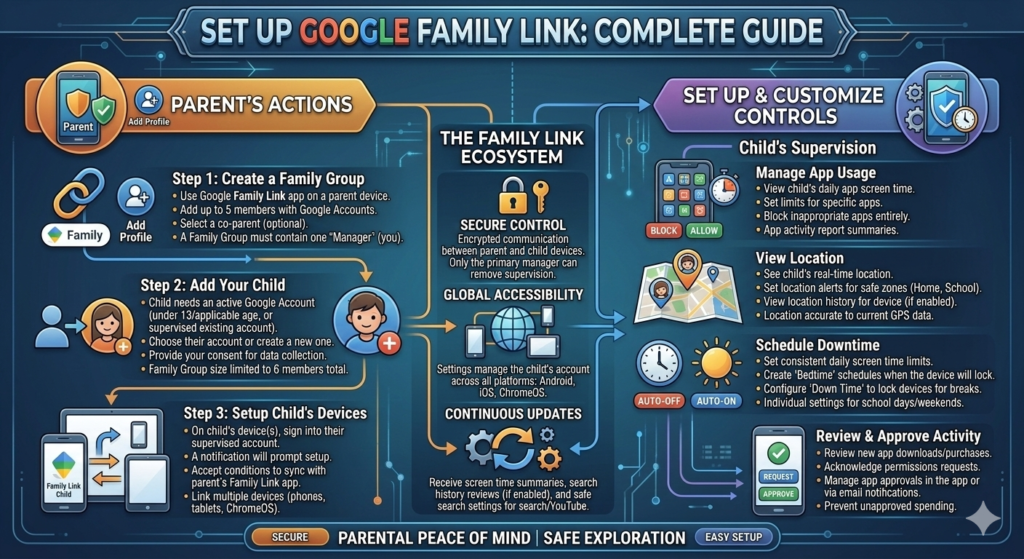
Google Family Link is a powerful free tool that helps you manage your child’s digital life, from screen time limits to app approvals and location tracking. This comprehensive guide walks you through everything you need to know about setting up and using Family Link effectively.
What Is Google Family Link?
Google Family Link is a parental control app that allows you to set digital ground rules for your child’s Android device or Chromebook . With it, you can:
- Manage screen time: Set daily limits and bedtime schedules
- Approve or block apps: Control what your child downloads
- See device location: Track where your child is (on Android devices)
- Set content filters: Restrict mature content on Google services
- View activity reports: See how much time your child spends on each app
Best of all, Family Link is completely free with no subscriptions or hidden costs .
Before You Start: Requirements
Two Ways to Set Up Family Link
You can set up Family Link either during initial device setup (when setting up a new phone for your child) or on an existing device. We’ll cover both methods.
Method 1: Setup During New Device Configuration (Recommended)
This is the smoothest approach when you’re setting up a brand new phone for your child .
Step 1: Create or Sign In to Your Child’s Google Account
- Turn on your child’s new Android device
- Follow the initial setup prompts until you reach the “Sign in with a Google Account” screen
- Tap “Create a new account” and select “For my child”
- Enter your child’s first name, last name, and birth date
- Create a Gmail address and secure password
- Follow the prompts to connect your Google account as the parent
Step 2: Accept Parental Controls
- Google will ask you to review the supervision terms. Read them and tap “I Accept”
- You may need to verify your identity by entering your Google account password or completing two-factor authentication
- Choose whether to apply simple controls (same settings for everything) or customize each setting individually
Step 3: Configure Initial Restrictions
- Review and adjust settings for:
- Decide whether to allow Google services to share data
- Review and confirm all settings, then tap “Confirm”
Step 4: Set Screen Time Rules
- Configure a daily screen time limit (e.g., 2 hours per day)
- Set a bedtime schedule (e.g., 9 PM to 7 AM when the device locks automatically)
- Enable location sharing so you can see where your child is
Step 5: Complete Device Setup
- Choose which pre-installed apps your child can access
- Configure YouTube experience (YouTube Kids or supervised YouTube)
- Tap “Finish setup”
- Download the Family Link app on your own phone from the Play Store (Android) or App Store (iPhone)
Method 2: Setup on an Existing Device
If your child already has a device in use, follow these steps :
On Your Child’s Device:
- Open Settings
- Scroll down and tap “Digital Wellbeing and parental controls”
- Scroll to the bottom and tap “Set up parental controls”
- Tap “Get started” and select “Child or teen”
- Sign in with your child’s Google account (create one if needed)
- Follow the on-screen instructions to link to your parent account
On Your Parent Device:
- Install the Google Family Link app from the Play Store (Android) or App Store (iPhone)
- Open the app and sign in with your Google account
- Tap “Continue as [Your Name]”
- You should see your child’s account appear automatically
Using Family Link: Key Features
Once setup is complete, here’s how to use the main features from your parent device.
Managing Screen Time
- Open the Family Link app on your phone
- Tap “Screen time” or go to the Controls tab
- You’ll see options to:
Approving or Blocking Apps
When your child tries to download an app from the Google Play Store:
- They’ll see options to “Ask in a message” or “Ask in person”
- If they choose “Ask in a message,” you’ll receive a notification on your phone
- Open the Family Link app to Approve or Deny the request
To set limits on existing apps:
Setting Content Restrictions
Tracking Your Child’s Location
- In Family Link, tap the Location tab
- You’ll see your child’s current location on a map
- Pull up the menu and tap “Family places” to save important locations like home and school
- Once saved, you’ll receive notifications when your child arrives at or leaves these places
To make a lost device ring (even if on silent):
- In Family Link, go to Controls > select your child’s device
- Tap “Play sound” – it will ring for 5 minutes
Adding a Second Parent
Both parents can supervise your child’s account :
- Open Family Link on the primary parent’s device
- Tap your child’s profile
- Select Settings > Manage family members > Invite a family member
- Enter the second parent’s email address
- The second parent will receive an invitation to join
- Once accepted, they’ll have full access to manage settings from their own device
Family Link on iPhone: Important Limitations
If your child uses an iPhone or iPad, Family Link has significant limitations :
What Family Link CAN do on iOS:
- Manage Google services (Search, Chrome, YouTube, Gmail)
- Set SafeSearch filters
- Control YouTube Kids settings
What Family Link CANNOT do on iOS:
- Set screen time limits
- Block non-Google apps
- Track precise location
- Control App Store downloads
- Monitor app usage
For iOS devices, you may need Apple’s built-in Screen Time or third-party alternatives for full control.
When Your Child Turns 13
In most countries, children can choose to manage their own Google account when they turn 13 :
- On their birthday, they’ll receive a notification with the option to take over account management
- If they choose to end supervision, the device will be locked for 24 hours before the change takes effect
- This is a good opportunity to have a conversation about digital responsibility
Note: The age may vary by country (e.g., 14 in some European countries).
Troubleshooting Common Issues
Setup keeps failing or resetting
- This process can sometimes be buggy. Be patient—it may take 2-3 attempts
- Ensure your child’s account is part of your Google Family before starting
“Can’t find the setting”
- Make sure Family Link is supported in your country
- If using a work/school account, your administrator may have disabled it
Child bypassing restrictions
- While Family Link is robust, tech-savvy kids may find workarounds. Search online for tutorials to understand potential loopholes
Child turned 13 and wants to stop supervision
- They can manage their own account now. Have an open conversation about online safety moving forward
Quick Reference Card
| Task | Action |
|---|---|
| Install on parent phone | Play Store/App Store → “Google Family Link” |
| Set daily screen limit | Family Link → Controls → Daily limit |
| Set bedtime | Family Link → Controls → Downtime |
| Lock device now | Family Link → Controls → Lock |
| Approve app download | Respond to notification or check app requests |
| Track location | Family Link → Location tab |
| Add second parent | Profile → Settings → Manage family → Invite |
| Content filters | Controls → Content restrictions |
Final Checklist
✅ Parent and child have Google accounts
✅ Both devices meet minimum requirements
✅ Child’s device has only one Google account
✅ Family Link app installed on parent device
✅ Screen time limits configured
✅ Bedtime schedule set
✅ Content restrictions applied
✅ Location sharing enabled
✅ Second parent invited (if desired)
✅ Backup parent account info saved
Final Verdict
Google Family Link is an excellent free tool for parents who want to guide their children’s digital experiences. While setup can sometimes be finicky, the ongoing control it provides—from screen time limits to app approvals and location tracking—makes it invaluable for modern parenting .
Start with the basics: set a daily limit, configure bedtime hours, and enable content filters. As your child grows, you can adjust these settings and eventually have the conversation about digital independence when they turn 13.
For iOS users, be aware of the limitations and consider supplementing with Apple’s built-in controls or third-party alternatives for full device management.