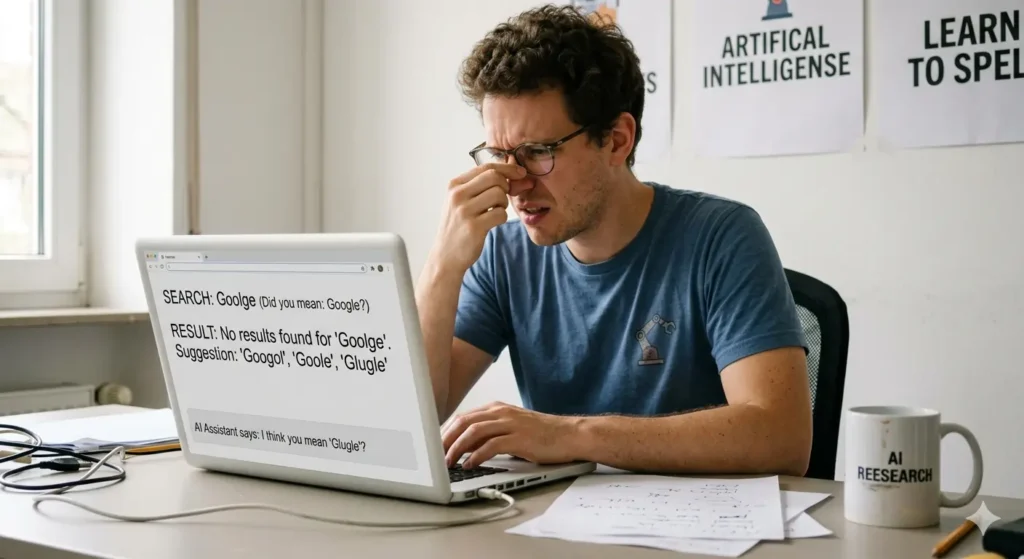
Google AI spelling mistakes are becoming one of the internet’s favorite jokes again.
Meanwhile, Google keeps pushing AI deeper into:
- Search
- Android
- Chrome
- Workspace
- Gemini products
However, users continue spotting bizarre spelling errors inside AI-generated summaries and responses.
Consequently, many people are now asking an awkward question:
how can Google’s AI struggle with spelling when Google literally built one of the world’s biggest search engines?
And honestly, some of the mistakes are genuinely embarrassing.
That growing frustration also connects directly to:
- DuckDuckGo Installs Jump 30% as Users Flee Google’s AI Takeover
- ‘Force-Fed AI’ Backfires: Google I/O 2026 Boosts DuckDuckGo Instead
- DuckDuckGo CEO Calls Out Google: ‘No Opt-Out, No Choice’
- iPhone Users Are Ditching Google for DuckDuckGo at Record Rates
- 6 Search Engines That Don’t Force-Feed You AI (DuckDuckGo Leads the Pack)
- Google’s AI Search Is Driving Users Straight to Privacy-First Engines
- DuckDuckGo vs. Perplexity vs. Brave: Which AI-Free Search Wins?
Why Google AI Spelling Mistakes Feel So Weird
Initially, spelling seems like one thing AI should easily handle.
Meanwhile, Google spent decades building:
- autocorrect systems
- spell checking
- predictive typing
- search correction tools
Consequently, users naturally expect Google AI to produce polished text.
However, AI-generated summaries increasingly contain:
- spelling mistakes
- grammar problems
- repeated phrases
- awkward wording
- incorrect names
Additionally, some users even reported Gemini occasionally misspelling “Google” itself during generated outputs.
Because of that, online reactions quickly turned into memes and criticism.
AI Is Very Good at Sounding Confident
Importantly, large language models are designed to predict text patterns, not truly understand language.
Meanwhile, AI systems often prioritize:
- fluency
- speed
- conversational tone
- plausible wording
instead of guaranteed accuracy.
Consequently, AI can sometimes generate text that:
- sounds convincing
- reads naturally
- feels confident
while still being wrong.
Additionally, spelling mistakes become especially noticeable because users expect AI systems to appear polished.
Because of that, even tiny errors can damage trust surprisingly quickly.
Google Is Pushing AI Everywhere Anyway
Despite the criticism, Google continues aggressively integrating AI into:
- Search
- Gmail
- Docs
- Android
- Chrome
- Gemini
Meanwhile, Google I/O 2026 focused heavily on:
- AI summaries
- AI assistants
- AI-generated search
- Gemini integrations
across almost every product.
Consequently, many users now encounter AI-generated text constantly while using Google services.
Additionally, the more AI appears in daily workflows, the more visible these mistakes become.
Because of that, spelling errors now attract much more attention than before.
Users Expected Google to Do Better
Honestly, part of the backlash comes from expectations.
Meanwhile, smaller AI startups sometimes receive more forgiveness when errors happen.
However, Google built its reputation around:
- information accuracy
- search quality
- spelling correction
- language processing
Consequently, users expect much higher standards from Google AI systems.
Additionally, Google’s scale makes even small AI mistakes feel globally visible almost instantly.
Because of that, screenshots of weird AI spelling errors spread across social media extremely quickly.
AI Search Still Feels Unfinished
Interestingly, many users increasingly describe AI-powered search as:
- inconsistent
- messy
- overconfident
- unreliable
Meanwhile, AI summaries sometimes:
- hallucinate facts
- misread sources
- generate strange wording
- confuse context
Consequently, spelling mistakes become symbolic of larger trust problems surrounding AI-generated search results.
Additionally, users often tolerate occasional errors less when AI systems present answers with complete confidence.
Because of that, even simple spelling issues now reinforce broader skepticism toward AI search tools.
DuckDuckGo and Privacy Search Engines Benefit
Meanwhile, Google’s aggressive AI rollout already pushed some users toward:
- DuckDuckGo
- Brave Search
- Kagi
- traditional search results
instead of AI-heavy interfaces.
Consequently, critics increasingly argue users want:
- cleaner search
- fewer AI summaries
- direct website links
- less algorithmic interference
Additionally, AI mistakes make some users nostalgic for simpler search experiences overall.
Because of that, Google’s AI push may accidentally help competing search engines grow faster.
AI Still Makes Strange Human Errors
Interestingly, AI mistakes often resemble:
- tired typing
- rushed writing
- distracted editing
- autocorrect failures
instead of traditional software bugs.
Meanwhile, AI systems sometimes:
- repeat words
- invent spellings
- confuse names
- produce awkward sentence structure
in surprisingly human ways.
Consequently, users sometimes find AI errors both:
- funny
- unsettling
at the same time.
Additionally, these strange mistakes remind people that AI still does not truly “understand” language like humans do.
Google Probably Won’t Slow Down
Importantly, Google shows no signs of reducing its AI expansion plans.
Meanwhile, competitors including:
- Microsoft
- OpenAI
- Meta
- Apple
continue racing aggressively toward deeper AI integration too.
Consequently, companies increasingly prioritize:
- AI assistants
- AI search
- automated workflows
- generated summaries
across nearly every product category.
Additionally, fixing spelling mistakes is probably much lower priority than scaling AI adoption quickly.
Because of that, users may continue seeing awkward AI-generated errors for quite a while.
The Bigger Problem Is Trust
Honestly, spelling mistakes themselves are not catastrophic.
However, they create a bigger psychological problem:
trust.
Meanwhile, users expect:
- search engines
- productivity tools
- AI assistants
to produce reliable information consistently.
Consequently, small spelling errors can make users question:
- factual accuracy
- source reliability
- AI confidence
- generated summaries overall
Additionally, once trust weakens, users start examining every AI answer more critically.
Because of that, even tiny mistakes can quietly damage confidence in AI systems over time.
Final Thoughts
Google AI spelling mistakes may sound funny at first.
However, they reveal a much larger problem surrounding:
- AI reliability
- trust
- automated search
- generated information quality
Meanwhile, Google continues aggressively expanding AI into nearly every product it owns.
Consequently, users increasingly encounter AI-generated writing constantly throughout daily internet use.
Additionally, spelling mistakes make these systems feel far less polished than companies often promise.
And surprisingly, one of the biggest problems with modern AI may not be advanced hallucinations at all.
It may simply be that people still expect computers to spell correctly.