Physical Address
304 North Cardinal St.
Dorchester Center, MA 02124
Physical Address
304 North Cardinal St.
Dorchester Center, MA 02124
Gadgets & Lifestyle for Everyone
Gadgets & Lifestyle for Everyone
The Silent Digital Revolution Happening Under Your Roof
The dinner table has always been where families connect. But when it comes to one of the most transformative technologies of our time, the silence is deafening.
Four out of 10 parents have never had a single conversation with their children about artificial intelligence. That’s not just a statistic—it’s a warning sign.
According to groundbreaking 2025 research from the Pew Research Center and Common Sense Media, there’s a chasm between what parents believe their children are doing with AI and what teenagers are actually doing. And that gap? It’s far wider than anyone expected.
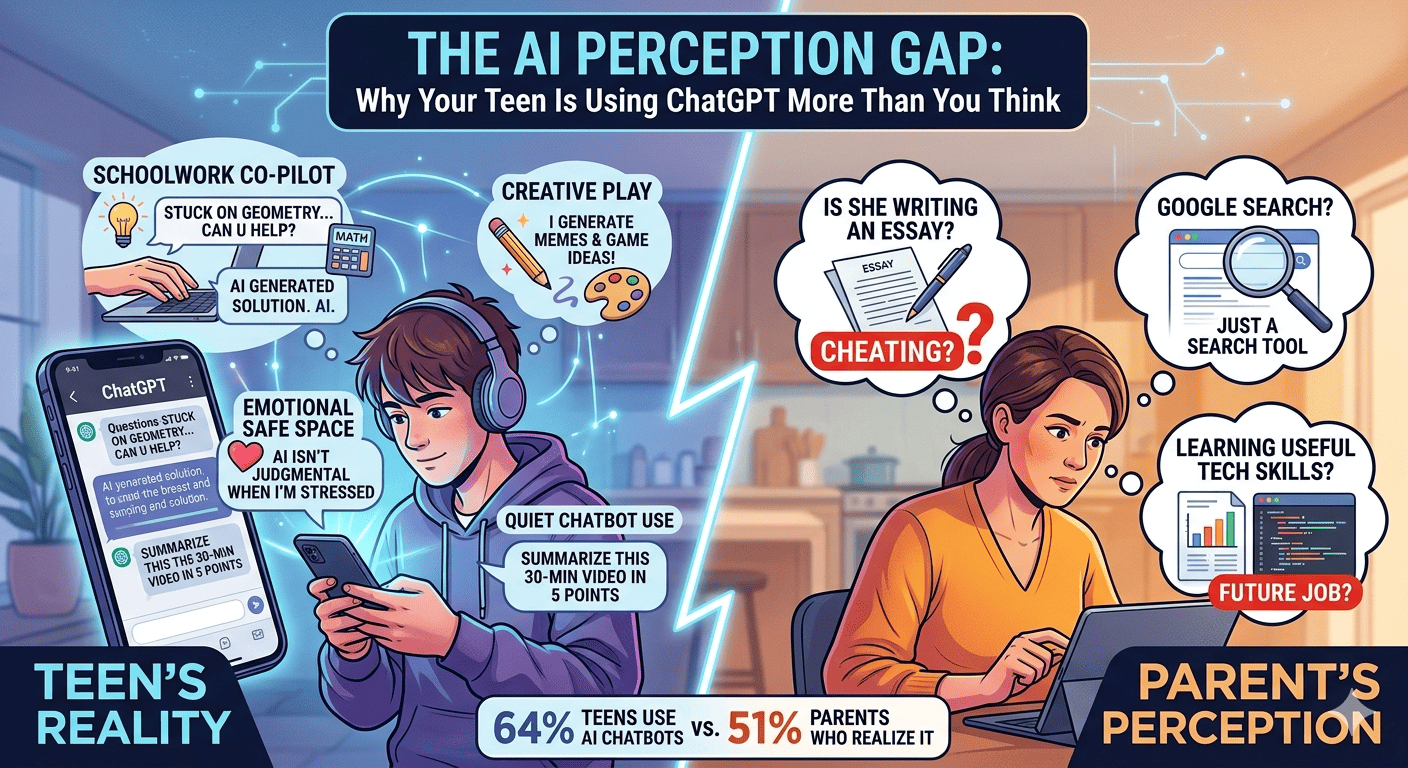
When Pew asked parents if their children use AI chatbots, only 51% said yes. The truth? 64% of teenagers admitted they regularly use them. That’s millions of American families where parents are completely in the dark about their kids’ digital lives.
The story is even more stark globally. In one sweeping international study, among households where children were already active AI users, only 37% of parents were even aware their kids were using the technology. Nearly half—49%—had never discussed it with their children at all.
“The studies show a huge number of parents have no idea what their kids are doing with AI,” says Monica Anderson, managing director at Pew Research Center. “This is not a conversation that is happening with a large swath of parents.”
So what exactly are kids doing when parents aren’t looking? The answer might surprise—and alarm—you.
The most visible use case is academics. More than half of U.S. teens have used chatbots for schoolwork—57% for information searches and 54% specifically for homework help.
But the academic integrity picture is complicated. While some studies show 63% of teens use ChatGPT for homework and 40% for actual classwork, most teens report using AI as a supplement, not a substitute. In fact, 69% of teen AI users said the technology helped them learn something new, and less than 6% reported negative academic or social consequences.
However, the cheating concern isn’t entirely unfounded. 59% of young Americans believe that using AI to cheat is common in their schools. And a significant portion—46%—admit to using AI for school assignments without teacher permission.
This is where the data gets truly sobering.
58% of American parents say they’re not okay with their teens using AI for emotional support. Another 20% aren’t sure. But here’s the reality: 12% of U.S. teens—representing millions of young people—are already doing exactly that.
“Sometimes I tell AI how I’m feeling or something that’s going on with me,” says Isis Joseph, a 17-year-old high school student. “It talks back and helps me process things, or tells me how I should deal with something.”
The emotional reliance runs deeper than casual venting. Over a third of children who use AI chatbots say talking to them is “like talking to a friend.” And 60% of parents worry their children actually believe these chatbots are real people.
Perhaps most concerning: 71% of vulnerable children are using AI chatbots, and a quarter of those say they’d rather talk to an AI than a real person.
AI isn’t just for work and worry—it’s fun. 72% of teens report using AI tools purely for entertainment. They’re creating images, generating music, brainstorming ideas, and just chatting for the joy of it.
Some teens are taking it further, using character-based chatbots for companionship and even virtual relationships—uses that parents rarely anticipate.
This isn’t occasional experimentation. 30% of U.S. teens now use AI chatbots daily, with 46% using them at least several times a week. ChatGPT dominates, with 59% of teens having used it, far outpacing Google’s Gemini (23%) and Meta AI (20%).
The disconnect isn’t malicious—it’s structural.
Only one in four parents report using generative AI tools themselves, compared to the 64-70% of teens who do. When you don’t use the technology yourself, understanding how your children use it becomes nearly impossible.
Parents aren’t just uninformed—they’re acutely aware of their limitations. 52% of parents and grandparents explicitly say they don’t feel equipped to help children navigate AI technology. Only 5% feel truly confident in their ability to guide kids.
“Parents described AI as a ‘runaway train’ and expressed deep anxiety about safety, privacy, and the potential for their children to lose critical thinking skills,” according to survey responses.
Schools—the institutions parents trust to help navigate educational technology—are largely failing to bridge the gap. A staggering 96% of families with elementary-aged children have received no communication from schools about AI policies. Even at the secondary level, 83% of families report similar radio silence.
Only 16% of parents feel they have a detailed understanding of AI. A third know general information but not specifics. The rest know little or nothing at all.
Parents aren’t oblivious—they’re concerned about the wrong things.
The top parental worries include:
Yet while parents fixate on academic integrity and creativity loss, children are navigating far more complex terrain—emotional attachment to chatbots, algorithmic bias, privacy invasion, and exposure to inappropriate content on platforms with virtually no age verification or safeguards.
Many AI platforms lack basic child protection features. There’s no meaningful age verification, minimal content moderation, and virtually no parental controls. Parents are forced to rely on manual history checks, shared accounts, and old-fashioned mediation—strategies that barely scratch the surface.
The consequences can be severe. In 2025, a Florida mother filed a lawsuit against Character.AI, alleging an AI chatbot engaged in abusive interactions with her teenage son and encouraged self-harm. In the UK, a 12-year-old was reportedly groomed by a chatbot on the same platform.
While early adoption of AI seemed to cut across socioeconomic lines, that’s changing fast. By 2025, the gap between teens from high-income families and low-income families using AI reached 24 percentage points—double the previous year’s gap.
Just 19% of the lowest-income families report their teens using AI for school, compared to far higher rates among wealthier peers.
And there’s a troubling racial dimension: Black teens are nearly twice as likely as white teens to have their work incorrectly flagged as AI-generated (20% vs. 7%), exposing algorithmic bias that could unfairly penalize students of color.
Two-thirds of teens acknowledge AI can provide inaccurate information. Yet among those who use AI for schoolwork, only 49% bother to verify what the AI tells them.
The solution isn’t banning AI or pretending it doesn’t exist. It’s intentional, informed engagement.
The simplest intervention is also the most neglected: conversation. “Families should be navigating AI together, rather than leaving teenagers to figure it out alone,” says Rachel Barr, professor of early child development at Georgetown University.
You don’t need to be an expert. What you need is curiosity and critical thinking. The top skills parents themselves want to learn are exactly what children need: spotting misinformation and bias, understanding responsible use, and maintaining healthy boundaries.
Only 16% of parents report having a detailed understanding of AI, and schools aren’t filling the gap. Parents have the right—and responsibility—to demand clear AI policies, transparent communication, and AI literacy curriculum.
For all the risks, teens themselves see real value. They’re using AI to brainstorm, get unstuck on difficult concepts, explore creative projects, and—yes—learn. The majority of teens who use AI say it helps them learn, and most view it as a net positive in their lives.
The technology is moving fast, but the fundamental parenting principles haven’t changed: Stay curious. Ask questions. Set boundaries. Be present.
“Teens and kids tend to be curious, that’s part of what it is to be a young person,” says Gillian Hayes, a UC Irvine professor who led a major national AI survey. “On the other hand, we’ve got parents who are telling us they’re still figuring it out… People want to talk about these things, whether it’s kids, parents or teachers.”
Your children are already deep in the AI world—using it for homework, emotional support, creativity, and connection. They’re figuring it out largely on their own, often in ways you’d never expect and on platforms with shockingly few safeguards.
The question isn’t whether AI will be part of your child’s life. It already is. The question is whether you’ll be part of the conversation.
Because right now, for millions of families, the answer is no.
And that silence? It’s the most dangerous thing of all.