Physical Address
304 North Cardinal St.
Dorchester Center, MA 02124
Physical Address
304 North Cardinal St.
Dorchester Center, MA 02124
Gadgets & Lifestyle for Everyone
Gadgets & Lifestyle for Everyone
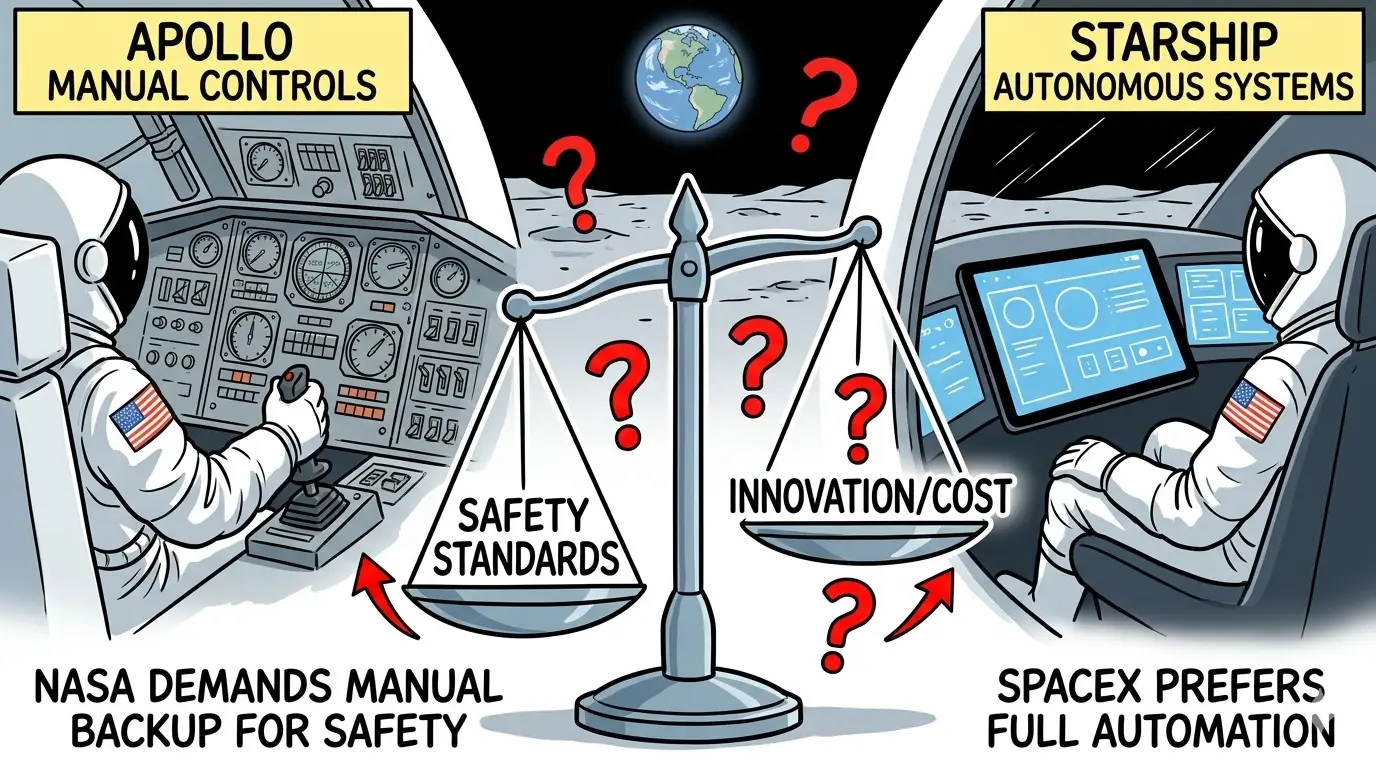
NASA’s inspector general released a new report on Tuesday examining the space agency’s management of the Human Landing System development contracts signed with SpaceX and Blue Origin. While the fixed-price contracting approach has generally been effective, the report reveals a significant disagreement between NASA and SpaceX over manual control requirements for the Starship lunar lander .
| Detail | Information |
|---|---|
| Report Source | NASA Office of Inspector General |
| Key Disagreement | Manual control requirements for Starship lunar lander |
| NASA’s Position | Astronauts need manual control capability during lunar descent |
| SpaceX’s Approach | Questioned by NASA as potentially insufficient |
| Risk Trend | “Worsening trend” in manual control risk per NASA tracking |
| Historical Context | Apollo astronauts used manual backup on every landing |
| Decision Point | Critical Design Review approaching; issue unresolved |
“There is disagreement between NASA and SpaceX on whether the provider’s current proposed approach for landing meets the intent of the Agency’s manual control requirement.”
The inspector general’s report notes that despite SpaceX’s acknowledgment and commitment to meeting the requirement, NASA’s tracking indicates a “worsening trend” in manual control risk .
During every Apollo program crewed lunar landing, astronauts engaged backup manual control methods. While Apollo flew six decades ago with far less sophisticated software, NASA maintains that crew override capability remains essential for safety .
The report emphasizes:
“Incorporating this system capability is a key element of HLS’s human-rating certification and part of an essential crew survival strategy.”
Unlike Crew Dragon, which had extensive flight heritage from cargo missions before carrying humans, Starship will not have the same level of proven flight experience in its actual operating environment before crewed lunar missions .
NASA and SpaceX engaged in a similar debate during Crew Dragon development a decade ago:
That compromise was brokered by former NASA astronaut Garret Reisman, who was working at SpaceX .
NASA and SpaceX are nearing a Critical Design Review for the lunar lander. The manual control issue remains unresolved, and the report suggests this may result in automation being the only landing method .
A design for Blue Origin’s manual control system has not yet been made, according to the inspector general .
Both SpaceX and Blue Origin are required to fly uncrewed demonstration missions before human flights. Key limitations noted:
Overall, the inspector general found NASA’s fixed-price contracting approach beneficial:
“We found that the Agency’s contract approach has been effective at controlling costs and provided the HLS Program with insight into SpaceX’s and Blue Origin’s development of their lunar landers.”
Both providers have utilized NASA’s subject matter expertise and unique capabilities to advance their lander development .
| Aspect | Status |
|---|---|
| Manual Control Agreement | Not reached; NASA tracking “worsening trend” |
| Apollo Precedent | Manual backup used on every landing |
| Dragon Precedent | Compromise reached after similar debate |
| Critical Design Review | Approaching with issue unresolved |
| Blue Origin Status | Manual control design not yet made |
| Demo Flight Limitations | No life support, no elevator test, limited dust assessment |
If the disagreement isn’t resolved, Starship’s lunar landings could rely solely on automation, with no crew override capability. NASA’s human-rating certification requires manual control as an essential survival strategy—meaning this issue must be addressed before astronauts can fly .