Physical Address
304 North Cardinal St.
Dorchester Center, MA 02124
Physical Address
304 North Cardinal St.
Dorchester Center, MA 02124
Gadgets & Lifestyle for Everyone
Gadgets & Lifestyle for Everyone
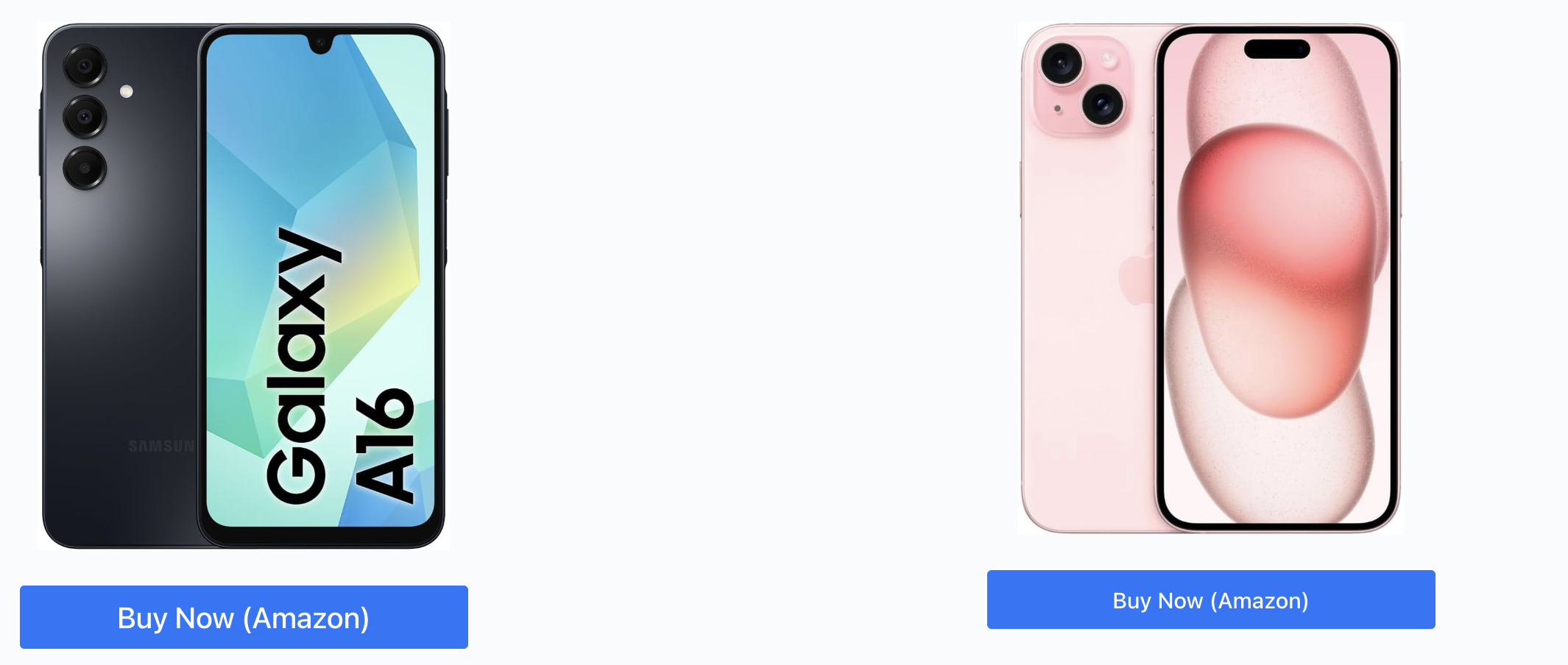
Choosing between the iPhone 15 and Samsung Galaxy A16 means comparing two phones from completely different worlds. The iPhone 15 is Apple’s premium standard-bearer from 2023, while the Galaxy A16 is Samsung’s budget-friendly workhorse from 2024. This iPhone 15 vs Samsung Galaxy A16 comparison helps you decide based on real user experiences.


| Feature | iPhone 15 | Samsung Galaxy A16 |
|---|---|---|
| Release Year | 2023 | 2024 |
| Operating System | iOS 17 (upgradable) | Android |
| Display Size | 6.1 inches | 6.7 inches |
| Display Type | Super Retina XDR OLED | AMOLED |
| Resolution | 2556 x 1179 (460 PPI) | 1080 x 2340 (385 PPI) |
| Refresh Rate | 60Hz | 90Hz |
| Processor | Apple A16 Bionic (3.46 GHz) | MediaTek Helio (2 GHz) |
| RAM | 8GB | 4GB |
| Storage | 128GB (non-expandable) | 128GB (expandable up to 1TB) |
| Main Camera | 48MP (f/1.6) | 50MP |
| Ultra-Wide Camera | 12MP | Yes (specs not detailed) |
| Third Camera | None | Depth sensor |
| Front Camera | 12MP | 13MP |
| Video Recording | 4K at 60fps | 1080p at 90fps |
| Battery Capacity | 3349 mAh | 5000 mAh |
| Battery Life (Talk Time) | 20 hours | 41.2 hours |
| Charging | USB-C, MagSafe wireless | USB-C, 25W fast charging |
| Biometric Security | Face ID | Fingerprint sensor (side-mounted) |
| SIM Type | eSIM only | Dual Nano SIM |
| Headphone Jack | USB-C only | 3.5mm jack |
| Water Resistance | IP68 | Water resistant (not IP rated) |
| Weight | 7.2 ounces (204g) | 200 grams (7.05 ounces) |
| Dimensions | 5.81 x 2.82 x 0.31 inches | 6.47 x 3.07 x 0.31 inches |
| Colors Available | Pink (and others) | Black |
| Target Audience | Premium iOS users | Budget-conscious users |
| Best For | Photography, performance, ecosystem | Large screen, expandable storage, affordability |
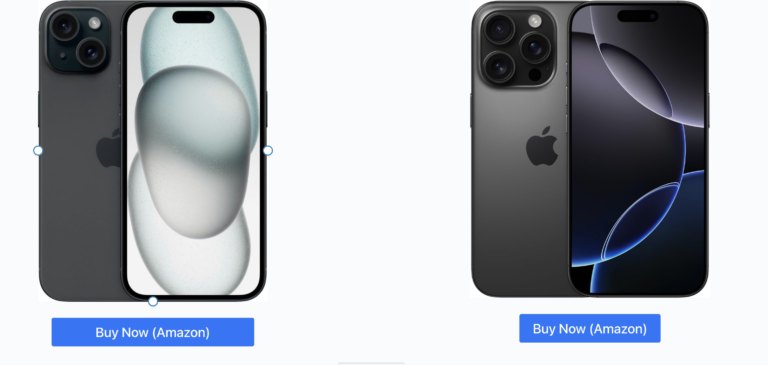
The iPhone 15 features a stunning design with an aerospace-grade aluminum frame and a beautiful matte glass back that resists fingerprints and feels incredibly premium in hand . At just 6.1 inches and 7.2 ounces, it’s remarkably compact and lightweight compared to modern smartphones. Users consistently praise how comfortable it feels to hold and use one-handed, with many preferring to use it without a case to appreciate its slim profile .
The Pink color option is particularly popular, described as “very light, very teen, very eye-catching” with a soft, understated tone . In this iPhone 15 vs Samsung Galaxy A16 comparison, the iPhone clearly wins for premium materials and build quality.
The Galaxy A16 takes a completely different approach with its massive 6.7-inch display housed in a plastic body. While it lacks the premium materials of the iPhone, users appreciate the practical design features. The side-mounted fingerprint reader integrated into the power button works well and is conveniently placed . The phone also offers splash resistance, making it a durable choice for everyday use .
User Experience Verdict: iPhone 15 wins for those who value premium feel and one-handed usability. Galaxy A16 wins for those wanting a large screen in a practical, durable package.
The iPhone 15 features a 6.1-inch Super Retina XDR OLED display with 2556 x 1179 resolution and 460 pixels per inch. Colors are vibrant, contrast is excellent, and the 2000-nit peak brightness makes it exceptionally usable even in direct sunlight . Users consistently praise the display quality, noting that it handles HDR content beautifully and provides an immersive viewing experience .
The major drawback? The 60Hz refresh rate. In 2026, this feels dated, especially when many mid-range Android phones offer 90Hz or 120Hz displays. Users who scroll a lot or play games will notice the difference in smoothness .
The Dynamic Island replaces the notch, offering interactive notifications and multitasking that users find genuinely useful and modern-looking .
The Galaxy A16’s 6.7-inch AMOLED display is its standout feature at this price point. With 1080 x 2340 resolution and a 90Hz refresh rate, scrolling feels smoother than the iPhone 15 despite the lower pixel density (385 PPI) . Users describe the display as “vibrant” and “saturated” with excellent color reproduction .
The 90Hz refresh rate makes a noticeable difference in daily use—scrolling through social media, browsing websites, and navigating the interface all feel more fluid than on the iPhone’s 60Hz panel.
User Experience Verdict: iPhone 15 offers superior image quality and brightness. Galaxy A16 offers a larger screen with smoother scrolling. Choose based on whether you prioritize pixel-perfect quality or silky-smooth motion.
The A16 Bionic chip with 8GB RAM delivers flagship-level performance that handles absolutely everything with ease . Users report that the phone never stutters or lags, whether switching between apps, editing photos, or playing graphics-intensive games . The 5-core GPU provides excellent gaming performance, though some users note the phone can warm up during extended gaming sessions or video recording .
The 8GB of RAM ensures smooth multitasking, and iOS optimizations mean apps stay in memory longer than on many Android devices. With five years of guaranteed iOS updates, the iPhone 15 will continue receiving software support through 2028 .
Real user feedback: “During use, I almost never experience any lag, even when continuously switching between many heavy applications, editing photos, editing short videos, or playing high-graphics games” .
User experiences with the Galaxy A16’s performance are decidedly mixed. The MediaTek Helio processor with 4GB RAM is adequate for basic tasks, but users report inconsistent performance .
Positive experiences: Many users find it “smooth and seamless for everyday tasks like texting, calls, and internet browsing” . One user noted it’s “more fluid than the A15” , while another called it “quick enough, storage large, camera takes good photos” . Parents consistently praise it as an ideal first phone for children or for elderly users who need basic functionality .
Negative experiences: Some users report “frequent freezing and app crashes” , “settings and widgets behave unpredictably” , and “login processes can be cumbersome with multiple password attempts needed” . One frustrated user wrote: “Everything is long, jerky and far from fluid. For a recent smartphone, it’s frankly insufficient” .
The 4GB RAM is a limiting factor. As one experienced user noted, “Sometimes you have to wait a second or two for an app to start” .
User Experience Verdict: iPhone 15 delivers consistent, reliable flagship performance. Galaxy A16 offers adequate basic performance but with occasional glitches that may frustrate users who demand smoothness.
The 48MP main camera with f/1.6 aperture delivers “sharp, detailed photos with excellent HDR processing” . Users consistently praise the camera quality, especially for portraits. Skin tones appear natural and rosy, with excellent detail retention even in challenging lighting .
Strengths:
Weaknesses:
Real user feedback: “I really like the image quality when shooting human subjects on iPhone. Skin tone is rendered very rosy, overall detail is very good; small details on the face are not erased or over-processed like many other products” .
The 50MP main camera produces “clear, high-quality photos” that impress users given the price point . The triple-camera setup (main, ultra-wide, depth) provides versatility, though quality varies.
Strengths:
Weaknesses:
User feedback: “For the money it makes even good photos” noted one user, while another mentioned “passable photos” as an accurate description .
User Experience Verdict: iPhone 15 offers vastly superior camera performance with reliable results in all conditions. Galaxy A16 takes decent photos in good light but struggles elsewhere—fine for casual users who don’t prioritize photography.
The 3349mAh battery provides solid all-day performance for most users. With moderate to heavy usage, you’ll comfortably make it through a full day . In video streaming tests, it achieved 12 hours and 21 minutes .
Charging:
The USB-C adoption is a major win for users who appreciate using the same charger for all their devices .
The 5000mAh battery is significantly larger on paper, but user experiences vary widely.
Positive experiences: Some users report “battery life generally lasts long enough for extended daily use” and “easily lasts all day, often more” .
Negative experiences: Others report “end of day at 20%” even with moderate use, with one user noting their 4-year-old A21 retained 50% charge at the same point in the day . Notification delays when the phone is in use also frustrate some users .
Charging:
User Experience Verdict: iPhone 15 offers consistent, predictable battery performance. Galaxy A16 offers larger capacity but inconsistent real-world results—you might get excellent life or disappointing endurance.
iOS delivers a smooth, intuitive experience with deep integration across Apple’s ecosystem. Features like iMessage, FaceTime, and seamless handoff with Mac and iPad create a cohesive experience for users invested in Apple products .
Software advantages:
Samsung promises software updates through 2030, an impressive commitment for a budget device . One UI provides extensive customization options, and the phone supports NFC payments .
Software challenges:
User Experience Verdict: iPhone 15 offers a more polished, reliable software experience. Galaxy A16 offers flexibility and long support but with occasional quirks.
| Aspect | iPhone 15 | Samsung Galaxy A16 |
|---|---|---|
| Design | Premium, compact, elegant | Large, practical, plastic |
| Display | Superior quality, 60Hz | Large, 90Hz smooth, budget quality |
| Performance | Flagship, reliable | Adequate but inconsistent |
| Camera | Excellent, versatile | Good in good light, struggles elsewhere |
| Battery | Consistent all-day | Inconsistent—great or disappointing |
| Software | Polished iOS, long support | Flexible Android, very long support |
| Best For | Users who want premium experience | Budget-conscious users |
The iPhone 15 delivers a consistently excellent user experience with premium design, reliable performance, and outstanding camera quality. It’s the choice for users who value polish and don’t want to compromise on daily experience .
The Samsung Galaxy A16 offers remarkable value for its price, with a large 90Hz display, decent camera, and long software support. However, user experiences vary significantly—some find it perfectly adequate, while others encounter frustrating glitches . It’s best suited for users with modest expectations or those buying for family members who need basic functionality .
Your iPhone 15 vs Samsung Galaxy A16 choice ultimately comes down to what you value most: premium reliability or budget-friendly practicality.