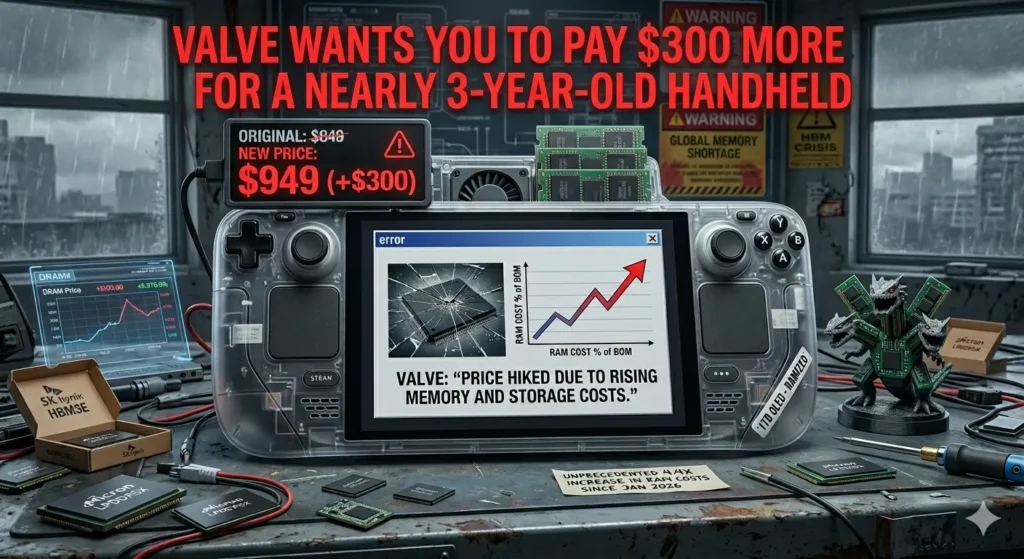
The Steam Deck price hike is creating a very strange situation for gamers.
Meanwhile, the Steam Deck is approaching its third year on the market.
However, instead of becoming cheaper like most aging gaming hardware, some OLED models reportedly now cost up to $300 more than before.
Consequently, many gamers are asking a simple question:
why is an older handheld suddenly becoming more expensive?
And honestly, the answer says a lot about the current state of the entire tech industry.
Additionally, the Steam Deck price hike completely changes how buyers compare Valve’s handheld against:
- gaming laptops
- desktop PCs
- ASUS ROG Ally systems
- Lenovo Legion Go devices
Consequently, the Steam Deck no longer feels like a low-cost handheld gaming PC.
That growing problem also connects directly to:
- Steam Deck Price Increase Hits OLED Models Hard
- Steam Deck RAM Shortage Sends Prices Soaring
- Affordable PC Gaming Is Dead: Steam Deck Price Hike Kills the Dream
Why the Steam Deck Price Hike Feels So Strange
Normally, gaming hardware gets cheaper over time.
Meanwhile, consoles and handheld systems traditionally become:
- more affordable
- easier to manufacture
- heavily discounted
- accessible to mainstream buyers
after several years on the market.
However, the Steam Deck price hike completely reversed that pattern.
Consequently, newer Steam Deck OLED models now approach:
- gaming laptop pricing
- desktop PC territory
- premium ultrabook costs
instead of becoming budget-friendly handhelds.
Additionally, many gamers expected Valve to reduce prices before eventually releasing a next-generation device.
Because of that, the increases feel unusually aggressive for older hardware.
Memory Shortages Changed Everything
Importantly, the Steam Deck price hike reportedly happened because of:
- DRAM shortages
- NAND storage pricing
- supply chain pressure
- rising component costs
Meanwhile, AI infrastructure companies continue consuming enormous amounts of:
- RAM
- flash memory
- SSD storage
- server hardware
Consequently, gaming hardware manufacturers increasingly struggle securing affordable components.
Additionally, portable gaming devices now compete against:
- AI hyperscalers
- cloud providers
- enterprise hardware firms
- data center operators
for the same memory supply.
Because of that, older hardware no longer automatically becomes cheaper to manufacture.
How the Steam Deck Price Hike Changed Portable Gaming
Initially, the Steam Deck became popular because it offered:
- affordable PC gaming
- portable flexibility
- massive Steam compatibility
- strong performance
without requiring expensive gaming laptop money.
However, the Steam Deck price hike dramatically changed that image.
Consequently, many buyers now compare the handheld directly against:
- gaming laptops
- desktop gaming PCs
- ASUS ROG Ally systems
- Lenovo Legion Go devices
instead of comparing it against:
- Nintendo Switch
- entry-level consoles
- budget gaming hardware
Additionally, premium OLED configurations now feel much closer to enthusiast hardware territory overall.
And honestly, seeing a Steam Deck approach $1,000 still feels surreal.
Valve Is Not Alone
Interestingly, the Steam Deck situation reflects a broader hardware problem.
Meanwhile, gaming laptops, SSDs, RAM, and handheld PCs all continue increasing in price because of:
- memory shortages
- AI demand
- premium component costs
- supply chain instability
Consequently, the entire gaming hardware market increasingly focuses on:
- premium buyers
- enthusiasts
- creators
- multitasking-heavy users
instead of mainstream gamers.
Additionally, manufacturers increasingly prioritize:
- OLED displays
- workstation-level memory
- creator-focused features
- premium materials
instead of affordability.
Because of that, gaming hardware overall feels less budget-friendly than it did several years ago.
Portable Gaming PCs Are Becoming Luxury Devices
Initially, handheld gaming PCs felt like:
- enthusiast gadgets
- secondary gaming systems
- portable alternatives
- affordable gaming machines
However, the category increasingly resembles:
- premium ultrabooks
- portable workstations
- creator laptops
- high-end gaming systems
instead.
Consequently, companies now compete heavily through:
- display quality
- multitasking
- creator workflows
- premium hardware design
rather than low prices.
Additionally, modern handheld gaming PCs now include:
- OLED panels
- high-speed SSDs
- advanced cooling
- workstation-level memory
Because of that, the category keeps drifting further into premium pricing territory.
Gamers Are Reacting Badly
Meanwhile, online reactions to the Steam Deck price hike have been extremely negative.
Many gamers argue the Steam Deck succeeded because it balanced:
- affordability
- flexibility
- portability
- PC gaming freedom
better than competing devices.
Consequently, massive price increases threaten one of Valve’s biggest advantages.
Additionally, many users now question whether:
- handheld portability
- SteamOS optimization
- OLED upgrades
- flexible controls
justify nearly laptop-level pricing.
And honestly, some buyers may simply decide to build desktops instead.
Why the Steam Deck Price Hike Hurts Budget Gamers
Interestingly, rising handheld PC prices may help traditional consoles.
Meanwhile, PlayStation, Xbox, and Nintendo still offer:
- lower upfront pricing
- optimized gaming experiences
- predictable costs
- stable ecosystems
Consequently, some casual gamers may move back toward traditional consoles instead of portable PC gaming.
Additionally, handheld gaming PCs increasingly feel designed more for:
- enthusiasts
- creators
- premium buyers
than mainstream audiences.
Because of that, affordable portable gaming feels much harder to find overall.
Could the Steam Deck Price Hike Last All Year?
Possibly, but not anytime soon.
Meanwhile, experts continue warning about:
- ongoing DRAM shortages
- NAND pricing pressure
- AI infrastructure expansion
- unstable supply chains
throughout 2026.
Consequently, gaming hardware prices may remain unpredictable for quite a while.
Additionally, AI infrastructure growth continues increasing pressure on global memory supply.
Because of that, the Steam Deck price hike may not be temporary at all.
Final Thoughts
The Steam Deck price hike feels strange because older gaming hardware almost never becomes dramatically more expensive.
Meanwhile, AI-driven memory demand now affects:
- handheld gaming PCs
- gaming laptops
- SSD pricing
- RAM availability
- consumer electronics
across the entire tech industry.
Consequently, affordable portable PC gaming is becoming increasingly difficult to maintain.
Additionally, Valve now faces the difficult challenge of balancing:
- premium hardware
- rising costs
- gamer expectations
- portable performance
simultaneously.
Furthermore, the Steam Deck price hike may signal a larger industry shift where portable gaming hardware increasingly targets:
- enthusiasts
- creators
- premium buyers
- multitasking-heavy users
instead of mainstream gamers looking for affordable gaming hardware.
And surprisingly, the Steam Deck’s biggest problem may not be aging hardware at all.
It may simply be the rising cost of the tiny memory chips inside it.