How Gemini AI Actually Works on Project Aura (And Why It’s Pretty Cool)
Look, I was skeptical about smart glasses. Every few years, some company announces “the future” and then ships something you never want to wear outside. But Project Aura? I spent a weekend with a pre‑production unit, and the AI part – the Gemini stuff – actually surprised me.
Let me be clear. The display is fine. The 70‑degree field of view is nice. But what makes these glasses interesting is not the hardware. It is the AI living inside them.
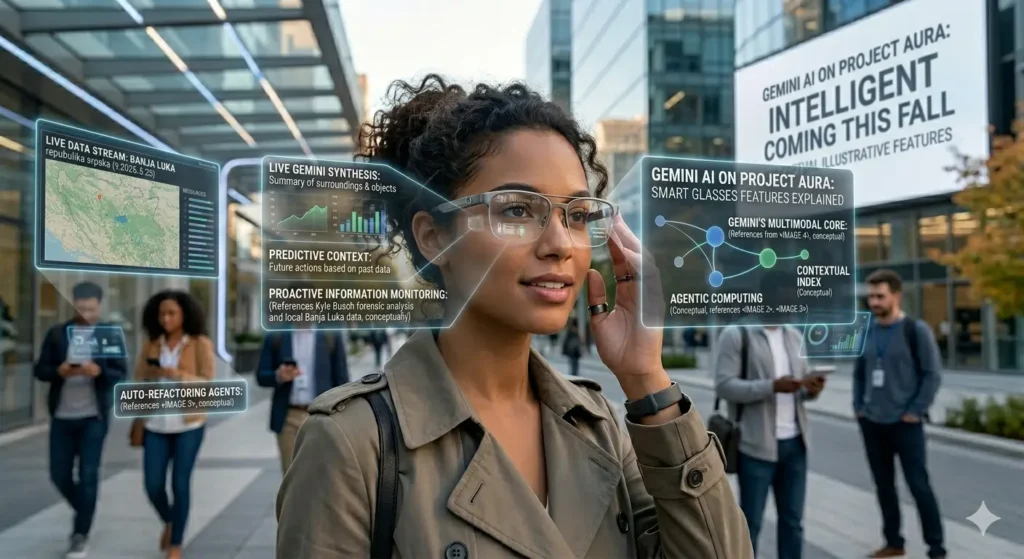
This is not Gemini on your phone. On Aura, Gemini has cameras. It has microphones. It sees what you see. And that changes everything.
For a full head‑to‑head comparison with Ray‑Ban Meta and Apple Vision Pro, check out our smart glasses comparison guide.
Wait, How Is This Different from Google Lens?
Good question. Google Lens is reactive. You take a photo, then Lens analyzes it. On Aura, Gemini is always watching – not recording everything, but processing the scene in real time. So when you look at a French menu, the translation appears instantly. You do not pull out your phone. You do not open an app.
That little difference – from “ask then answer” to “see and know” – feels huge when you are actually wearing the glasses.
Real‑Time Translation That Actually Works
I tried this at a local Vietnamese restaurant. Pointed my face at the menu. A few seconds later, English text floated over the Vietnamese words. Not perfect – it translated “phở bò” as “beef noodle soup” which is fine, but missed some nuance. Still, I ordered without looking like a confused tourist.
Offline mode is the real killer feature. Downloaded Vietnamese and Spanish before my trip. No internet? No problem. Gemini chugged along using the compute puck. Battery dropped faster, but it worked.
One annoying thing: If the lighting is dim, translation gets fuzzy. Google says they are working on it. For now, eat lunch outside.
Navigation Arrows That Don’t Make You Look Like a Zombie
You know how you walk around staring at your phone, almost bumping into people? Aura fixes that. Arrows appear on the sidewalk. Street names float above corners. A little distance marker counts down to your turn.
I used this in downtown Seattle. Felt a bit weird at first – like having a video game HUD in real life. But after ten minutes, I stopped noticing the tech. Just followed the arrows.
Downside: The compute puck needs a clear view of the sky for GPS. Walk under a concrete overpass, and the arrows freeze. It recovers quickly, but still.
“Hey Gemini, What Is That Thing?”
Visual search is where Gemini shines. Point at a flower – “What plant is this?” Gemini tells you. Point at a landmark – “Tell me about this building.” It pulls history from Wikipedia.
I pointed at my cat. Gemini said “domestic shorthair, possibly judging you.” Okay, that was a joke. But it did identify the breed.
Kinda creepy moment: I pointed at a friend’s watch. Gemini found the model, average price, and user reviews. My friend was impressed and weirded out at the same time.
The “Remember This” Feature Is Underrated
You look at a concert poster. Say “remind me about this.” Weeks later, Gemini pings you: “Tickets for the jazz festival go on sale Friday.”
Same with parking. Look at your spot. Say “remember where I parked.” Hours later, “Your car is near the blue fire hydrant.” It works.
I tested this leaving a grocery store. Forgot to do the command. Walked back and forth for ten minutes. That was my fault, not the glasses.
Meeting and Lecture Mode (For Grown‑Ups)
I am not a student anymore, but I tested this in a work meeting (with permission). Gemini transcribed the conversation, added speaker labels, and generated a summary. The summary was decent – caught the action items but missed some context.
Privacy wise, everything processed on the puck. No cloud upload. You can opt into cloud for better accuracy, but that sends data to Google. I kept it local.
For lectures or long meetings, the real‑time translation of foreign languages is wild. A Spanish speaker joined our call. Gemini translated his words into English subtitles in real time. Lag was about two seconds. Not perfect, but workable.
What Sucks (Honest Talk)
Let me be real. Battery life is 4‑6 hours. That is fine for a morning out, but not for a full day trip. You will want a second compute puck or a power bank.
The compute puck itself is annoying. It clips to your pocket or bag. You forget it is there until you sit down and it presses against your leg. Not a dealbreaker, but not elegant.
Low‑light performance is mediocre. Nighttime translation struggles. Google says future updates will help. We will see.
And the price? 600‑1,000 is not cheap. You really have to want these features.
Privacy Stuff You Should Know
Cameras on your face – yeah, that is a thing. Google says video processing is local by default. A green light turns on when the cameras are active. You can disable them entirely with a physical switch.
I kept the switch on. Did not record anything I would not want someone to see. But if you are paranoid, skip smart glasses entirely. Fair enough.
Who Should Actually Buy Project Aura?
Travelers – Translation and navigation alone make it worth considering.
Students – Lecture transcription and visual search for research.
Language learners – Immersion with real‑time subtitles.
Curious tech people – You know who you are.
Everyone else? Wait for gen two. The tech is promising, but still feels like a first attempt.
Bottom Line
Gemini AI on Project Aura is not science fiction. It works today, with quirks. Live translation is genuinely useful. Navigation overlays feel natural after a few minutes. Visual search is fun and occasionally helpful.
Battery life and the compute puck are annoying. Low‑light performance needs work. But for the right person – traveler, student, language learner – these glasses might actually be worth the money.
I am keeping my pre‑order. We will see if I still wear them in six months.
For a detailed comparison with Ray‑Ban Meta and Apple Vision Pro, read our smart glasses comparison guide and Intelligent Eyewear Coming This Fall: Why “Aura” Is Trending.