Smart glasses comparison is finally a meaningful conversation. For years, the category felt stuck between sci‑fi promises and awkward gadgets nobody actually wanted to wear outside the house. That is starting to change.
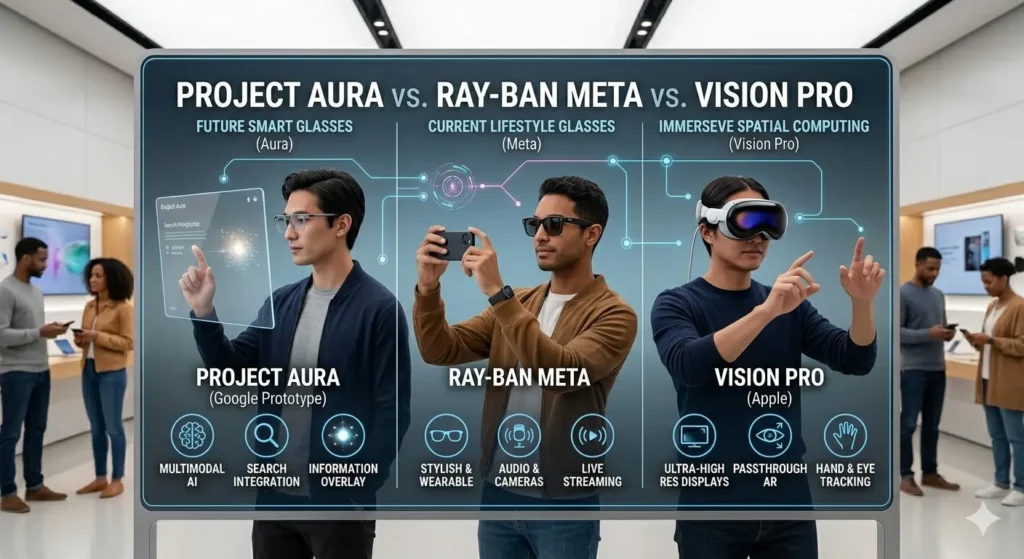
Three products now define the conversation: Google’s Project Aura, Meta’s Ray‑Ban Smart Glasses, and Apple’s Vision Pro. However, they are not really competing in the same way. One focuses on lightweight convenience. Another tries to replace your computer. The third wants to make augmented reality practical without strapping a heavy headset to your face.
That difference matters because most people do not actually want “the best smart glasses.” They want the one that fits their daily life.
After following all three products closely, I think each one has a very specific audience. Some are easier to recommend than others. This smart glasses comparison will help you decide which one belongs on your face.
For a complete look at Project Aura’s features, release date, and why it is trending, read our main Intelligent Eyewear Coming This Fall: Why “Aura” Is Trending article.
The Biggest Difference Nobody Talks About
Most comparisons focus on specs first. That is useful, but it misses the bigger point.
The real difference is this:
- Ray‑Ban Meta tries to disappear into your daily life.
- Vision Pro tries to replace your workspace.
- Project Aura tries to blend digital tools into the real world without isolating you.
That is why these products feel so different even before you compare cameras, displays, or AI assistants.
Quick Smart Glasses Comparison Table
| Feature | Project Aura | Ray-Ban Meta | Apple Vision Pro |
|---|---|---|---|
| Main purpose | Everyday AR | Smart camera glasses | Spatial computing |
| Display | Yes (70° FOV) | No | Yes |
| Weight | ~85‑90g | ~50g | ~600g |
| AI assistant | Gemini AI | Meta AI | Siri |
| Battery life | ~4‑6 hours | ~4 hours | ~2 hours |
| Estimated price | 600‑1,000 | 300‑400 | $3,500 |
| Best for | Productivity & AR | Social content | Immersive work |
Specs only tell part of the story. Once you actually imagine wearing these devices every day, the strengths and weaknesses become much clearer.
Ray-Ban Meta: Surprisingly Practical
Ray‑Ban Meta glasses are probably the easiest smart glasses to recommend to normal people right now. Why? Because they do not try too hard.
At first glance, they look like regular sunglasses. That alone solves one of the biggest problems in wearable tech. Most people do not want to look like they walked out of a sci‑fi movie while buying groceries.
The cameras, microphones, and speakers are hidden well enough that you stop thinking about the tech after a while. You can take quick POV videos, answer calls, listen to music, or ask Meta AI simple questions without touching your phone. Honestly, that simplicity is what makes them work.
What Ray-Ban Meta Gets Right
- Lightweight and comfortable.
- Looks almost normal in public.
- Great for creators and travelers.
- Easy social media integration.
- Affordable compared to competitors.
The pricing matters more than people realize. Spending 300‑400 on experimental tech feels manageable. Spending $3,500 does not.
Where Ray-Ban Meta Feels Limited
The problem appears once you expect more than convenience. You do not get floating apps or virtual screens here. There are no navigation overlays either. At the end of the day, Ray‑Ban Meta behaves more like a wearable camera and audio assistant than a true AR device. You are basically wearing a camera with speakers and AI attached.
Meta AI is also still fairly basic compared to Gemini. It handles simple tasks well enough, but deeper contextual conversations still feel limited. Battery life is another issue. Four hours disappears quickly if you record videos often.
Still, for many people, Ray‑Ban Meta might actually be the smartest purchase because it asks for the fewest compromises.
Apple Vision Pro: Incredible but Exhausting
Vision Pro feels like the future for about 20 minutes. Then your neck reminds you it exists.
That sounds harsh, but it is true. The technology inside Vision Pro is genuinely impressive. The displays are absurdly sharp. Eye tracking feels almost magical sometimes. Watching movies on it can feel like sitting alone in a private IMAX theater. Apple clearly built the most advanced product here from a technical perspective.
But there is a tradeoff. At around 600 grams, Vision Pro is heavy enough that you always notice it. You are not casually wearing this around the city or keeping it on during an entire afternoon. That changes how useful it feels in real life.
What Vision Pro Does Better Than Anything Else
- Best display quality in the category.
- Incredible immersion.
- Excellent hand and eye tracking.
- Strong productivity potential.
- Deep Apple ecosystem integration.
For creative professionals, that matters a lot. Designers, filmmakers, architects, and developers can genuinely benefit from large virtual workspaces.
The Problems Are Hard to Ignore
The biggest issue is not even the weight. It is the combination of weight, battery life, and price all at once. Two hours of battery life is rough for a device this expensive. Meanwhile, $3,500 pushes Vision Pro far outside mainstream territory.
There is also something psychologically tiring about wearing a full headset. Even when the experience is impressive, it can feel isolating after extended sessions. That is why Vision Pro currently feels more like a glimpse into the future than a product most people should buy today.
Project Aura: The Most Interesting Middle Ground
Project Aura feels like the company behind it actually asked an important question: “What if AR glasses were designed for everyday life first?” That approach changes everything.
Instead of putting all the hardware directly on your face, Aura uses a separate compute puck that handles processing. Some people will immediately hate that idea. Carrying another device in your pocket is not elegant. Still, there is a huge advantage. The glasses stay relatively light at around 85‑90 grams. That makes them dramatically more wearable than Vision Pro while still offering real augmented reality features.
Unlike Ray‑Ban Meta, you actually get a display.
Why Aura Feels More Practical
The 70‑degree field of view is large enough for genuinely useful AR experiences. You can see navigation overlays, use floating virtual screens, watch videos, translate signs in real time, and interact with Gemini AI contextually.
That last point matters a lot. Gemini feels significantly more advanced than Meta AI or Siri in this environment. Being able to ask questions about what you are actively looking at makes Aura feel closer to the original promise of smart glasses.
Android XR support is also important because it opens access to Android apps and Google services immediately.
The Downsides Are Real Too
The compute puck will annoy some people. There is no avoiding that. Battery life still is not “all day” territory either. Four to six hours is decent, although not revolutionary. The Android XR ecosystem is also brand new. Early adopters should absolutely expect bugs, missing apps, and rough edges during the first generation.
Even so, Aura currently feels like the most balanced vision of consumer AR.
Which One Feels Best in Daily Life? A Smart Glasses Comparison
This is where the differences become obvious.
If You Care About Style
Ray‑Ban Meta wins easily. Most people around you probably will not even realize you are wearing smart glasses. That matters more socially than tech companies like admitting. Project Aura is acceptable. Vision Pro is impossible to ignore.
If You Want the Best Visual Experience
Vision Pro dominates here. Nothing else comes close to the display quality or immersion level Apple delivers right now. Still, better visuals do not automatically mean better everyday usability.
If You Want Useful AI
Project Aura has the advantage. Gemini integration simply feels more capable for real‑world assistance, translation, contextual understanding, and productivity. Meta AI works fine for basic interactions. Siri still feels strangely behind in spatial computing scenarios.
If You Care About Comfort
Ray‑Ban Meta is the easiest to wear. Aura comes second because the split‑compute approach removes weight from the glasses themselves. Vision Pro is the least comfortable over long periods.
Real‑World Buying Advice
Go with Ray-Ban Meta if…
You mostly want convenience instead of a full AR experience. They are great for quick photos, casual videos, music, and hands‑free calls without looking overly futuristic in public. They also make the most sense if you use Instagram or Facebook constantly, want lightweight smart glasses, or are curious about wearable tech but do not want to spend a fortune. For most casual users, Ray‑Ban Meta is honestly the easiest recommendation.
Vision Pro Makes Sense if…
You care more about immersion than portability. Apple’s headset is best suited for developers, designers, filmmakers, and people who genuinely want a giant virtual workspace floating in front of them. The display quality alone is impressive enough to justify the hype. Still, the price and weight are hard to ignore. This is not really an impulse purchase.
Project Aura Feels Best for People Who Want “Real” AR
Aura sits in a very different category from Ray‑Ban Meta. If you want navigation overlays, virtual screens, live translation, and contextual AI help while walking around normally, Aura is probably the most interesting option right now. It especially makes sense for people already deep into Google services like Gmail, Maps, Gemini, and Android apps. More importantly, it actually feels wearable. That alone gives it a huge advantage over bulkier headsets.
The Bigger Picture
The most interesting thing about these products is not which one wins today. It is that they reveal where the industry is heading.
Ray‑Ban Meta proves people will wear smart glasses if they look normal. Vision Pro proves immersive computing can feel incredible under the right conditions. Project Aura tries to combine both ideas into something more practical.
Honestly, Aura might end up being the most important product long term even if it is not perfect at launch. Because people do not want a computer strapped to their face all day. They want technology that quietly helps them while they live normally. That is the real challenge smart glasses still need to solve.
For a deeper look at Project Aura’s features and release date, read our main Intelligent Eyewear Coming This Fall: Why “Aura” Is Trending article.