Google I/O 2026: The Year AI Became Your Agent
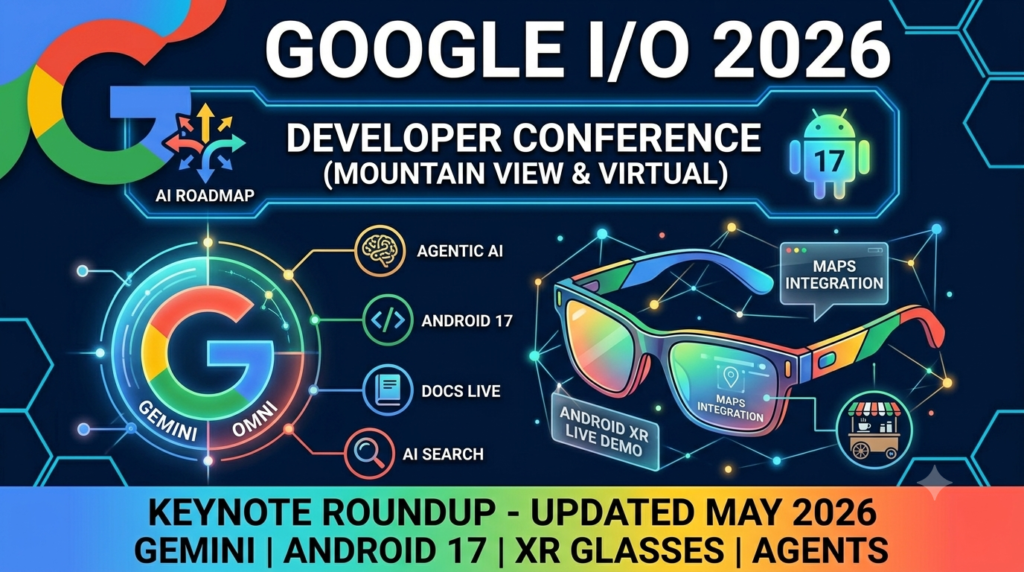
Google I/O 2026 was the company’s annual developer conference held on May 19–20, 2026 at the Shoreline Amphitheatre in Mountain View, California. This event marked Google’s full pivot from AI chatbots to autonomous AI agents – systems that don’t just answer questions but perform real-world tasks like booking flights, managing calendars, and even shopping on your behalf. Google I/O 2026 became the most talked‑about tech event of the year so far because of its aggressive pricing, surprise hardware, and the controversial debut of always‑on agents.
Why “Google I/O 2026” Is Trending Right Now
The keyword exploded on Google Trends and social media for several interconnected reasons. Gemini Spark, the autonomous agent demo, went viral – a live presentation showed an AI negotiating a dinner reservation across multiple restaurants while the user was asleep. The unexpected Googlebook laptop announcement also caught the tech world off guard, positioning Google as a direct competitor to Apple’s MacBook and Microsoft’s Surface. Furthermore, the price war on AI subscriptions (cutting the top tier from 250to100 per month) sparked intense debate about the sustainability of AI pricing. Finally, the controversy around replacing Google Assistant with Gemini and the privacy implications of “always‑on” agents drove massive engagement on Reddit, X, and YouTube.
What Is Google I/O and Why It Matters
Google I/O (Innovation in the Open) is the company’s flagship developer conference, held annually since 2008. It matters because nearly every major change to Google’s ecosystem – from Android to Search to AI – is first announced here. For developers, Google I/O 2026 provided new APIs, SDKs, and tools. For regular users, it previewed the features that will shape their phones, laptops, and smart devices for the next 12–18 months. This 2026 edition was the most AI‑centric I/O yet, with Google declaring the start of the “agentic era.”
Google I/O 2026 Keynote Highlights
The 105‑minute keynote was structured around three pillars: Agentic AI, Android Ecosystem, and Hardware. Key moments from Google I/O 2026 included:
- Gemini 3.5 Flash – The new default AI model, four times faster than previous versions, optimized for taking action rather than just answering.
- Gemini Spark – A continuous personal AI agent that runs on dedicated cloud VMs, demonstrated booking reservations, managing calendars, and coordinating with other tools autonomously.
- Googlebook – A brand‑new premium laptop built from the ground up for AI interaction, featuring a custom “Gemini Key” and AI Studio integration.
- Android 17 (Cinnamon Bun) – Announced ahead of schedule, with a focus on scam detection, desktop mode, and theft protection.
- Ask YouTube – A full conversational AI inside YouTube’s search bar, capable of answering complex questions by analyzing video transcripts.
Biggest Android 17 Announcements at I/O 2026
Contrary to earlier speculation that the conference would focus on Android 16, Google jumped straight to Android 17 (codenamed “Cinnamon Bun”), skipping a version number. The following table summarizes the most important features announced at Google I/O 2026.
| Feature | Description |
|---|---|
| Scam Detection AI | Identifies and automatically hangs up on fake bank calls before the scammer speaks |
| PC‑Style Desktop Mode | Full multi‑window, desktop experience when connected to an external monitor |
| Theft Detection Lock | Uses AI to detect if a phone is snatched and instantly locks the screen |
| APV Codec | Advanced Professional Video codec for high‑quality recording and editing |
| Material 3 Expressive | New motion‑physics system and emotional pattern design for animations |
| OTP Hiding | Hides one‑time passwords on the lock screen when the device is offline or recently locked |
Android 17’s beta will launch in August 2026, with stable release expected in March 2027.
Gemini AI Updates Announced at Google I/O
Gemini is no longer just a chatbot – it is becoming the operating system for Google’s entire ecosystem. According to the Google I/O 2026 roadmap:
- Gemini 3.5 Flash is now the default model across Google products. It supports a 2‑million token context window (able to process entire books or long codebases) and is optimized for low latency.
- Gemini Spark is a personal agent that runs continuously. It can perform tasks like scanning your inbox for urgent messages, rescheduling meetings when conflicts arise, and even “shopping” for you (comparing prices and making purchases) after explicit permission.
- Gemini Omni is a multimodal model that can take any input (text, image, video, audio) and generate video. It is being integrated directly into YouTube Shorts for AI remixing.
- AI Subscription Price Cut: The most advanced Gemini tier dropped from 250to100 per month, a clear response to competitive pressure from OpenAI’s ChatGPT Pro and Microsoft’s Copilot.
New Pixel Devices Revealed or Teased
Google had already launched the Pixel 10 series earlier in April, but Google I/O 2026 provided software updates and a tease for the future.
- Pixel 10 Pro Fold: Features an 8‑inch inner display with 120Hz refresh rate and 3000 nits peak brightness. The foldable received new AI‑powered multitasking features.
- Pixel 11 tease: The Pixel 11 series (expected late 2026) will feature a world‑first M16 OLED display and the Tensor G6 chip, designed specifically for on‑device Gemini processing.
- Pixel Feature Drops: “Comfort View” reduces visual stimulation from saturated colors, custom AI‑generated icons, and a SpongeBob SquarePants theme pack (a crowd‑pleasing surprise).
Wear OS Updates and Smartwatch Features
Wear OS is officially replacing the Google Assistant with Gemini. The Wear OS 6 update, rolling out in stages throughout 2026, has moved entirely to a generative AI‑native experience. The Google I/O 2026 presentation highlighted:
- Gemini App UX 2.0: A visual “glow‑up” featuring vibrant colors and animated gradient backgrounds on the watch face.
- Gemini Intelligence: More complex, multi‑step tasks can now be performed directly from the watch – for example, “Find me a nearby Italian restaurant with outdoor seating and text the address to my partner.”
Android XR / AR Glasses Announcements
One of the more unexpected announcements at Google I/O 2026 was the confirmation that the first Android XR smart glasses are coming in 2026, developed in partnership with XREAL.
- Project Aura: Lightweight AR glasses running Google’s Android XR OS, powered by Qualcomm’s Snapdragon AR2 Gen 2 chip. They provide real‑time translation, navigation overlays, and Gemini voice interaction.
- Audio Glasses: A separate pair of audio‑only glasses (no display) equipped with cameras, microphones, and speakers. Users can ask Gemini for restaurant reviews, translations, navigation, and even take photos with AI editing.
Google Search AI Changes
Search received its most significant visual overhaul in 25 years. The search box itself is now dynamic and AI‑powered – a direct result of Google I/O 2026 announcements.
- AI‑Powered Search Box: It expands to accommodate long, conversational queries. For example, instead of “best pizza NYC,” you can type “Find a pizza place in Brooklyn that has vegan options, is open now, and has outdoor seating.”
- Search Agents: Users can create programmable “information agents” within Search. An agent can track news before it breaks, monitor price drops on specific products, or manage shopping lists across multiple stores.
- Gemini 3.5 Flash Integration: AI Mode in Search now runs on the new model, providing faster inferencing and the ability to process images, video, and audio.
Chrome and Web Development Updates
Google is preparing the web for “agent‑ready” applications. The following updates were unveiled at Google I/O 2026:
- WebMCP Protocol: A new Chrome API that allows AI agents to interact directly with web page kernels (HTML, CSS, JavaScript) without simulating human mouse clicks and keyboard strokes. This makes agents vastly more efficient.
- DevTools Agents: AI agents integrated into Chrome DevTools allow developers to debug and optimize applications using natural language commands like “Find the memory leak in this React component.”
- Cross‑document View Transitions: A new API enabling seamless page transition animations, similar to app‑style navigation between pages.
Google Workspace AI Features
Workspace is becoming voice‑first and agent‑first. Google I/O 2026 introduced:
- Gmail Live & Docs Live: Users can talk to the AI to draft emails, create documents, or find items in their inbox using natural language. “Schedule a meeting with the marketing team for tomorrow at 2 PM and attach last week’s report.”
- Google Pics: A new image generation and editing tool built on Google’s “Nano Banana” platform, integrated directly into Workspace. It can generate diagrams, edit product photos, and create social media graphics.
- AI Inbox: Capable of generating contextual draft replies and providing instant file access when it detects urgent emails (e.g., “This email from your boss looks time‑sensitive – here’s the Q2 report you need”).
YouTube AI Tools
YouTube is embracing generative video AI at scale, as shown during Google I/O 2026.
- Ask YouTube: A full conversational search feature. Instead of keywords, users can ask, “Find me a video that explains how to fix a leaky faucet with step‑by‑step instructions,” and the AI will parse transcripts to find the exact timestamp.
- Gemini Omni for Shorts: The new multimodal model is integrated into YouTube Shorts, allowing creators to remix existing videos, add AI‑generated backgrounds, and even create short clips from long‑form content using text prompts.
Firebase and Developer Tools Improvements
Firebase received significant AI integration. Key announcements from Google I/O 2026 include:
- Agent Mode in Android Studio: Developers can use AI agents to set up Firestore and Firebase Authentication, generate code for Firestore, and write security rules using natural language.
- Hybrid Inference API: A new API allowing developers to route AI requests between on‑device and cloud models via a unified interface – for example, running simple tasks on the device and complex ones in the cloud.
- Spending Caps: Project‑level monthly spending limits for Gemini API calls, preventing surprise bills.
Google AI Studio and Gemini API Changes
- Gemini 3.5 Flash Live is immediately available in Google AI Studio, Antigravity, and Android Studio.
- Webhooks for Gemini API: Long‑running tasks (like video processing or large document analysis) can now be handled via event‑driven webhooks, eliminating inefficient polling.
- Project Spending Caps: Developers can now set monthly limits per project to control costs.
Privacy and Security Announcements
Security was a major focus at Google I/O 2026, particularly around banking scams and device theft.
- Verified Bank Calls: Android 17 can automatically verify if a call claiming to be from a bank is legitimate and hang up if it detects spoofing – addressing an estimated $980 million in annual losses from such scams in the US alone.
- OTP Hiding: One‑time passwords are hidden on the lock screen when the phone is offline or hasn’t been recently unlocked, preventing visual hacking.
- Remote Lock: Users can lock their device remotely using just their phone number and a security challenge, without needing to remember a Google account password.
Material Design Changes in Android 17
The visual identity of Android is shifting to Material 3 Expressive. This is not just a color change; it introduces a new motion‑physics system that makes animations feel more organic and responsive. The design focuses on “emotional patterns” to boost engagement and usability – for example, the UI can subtly pulse when you receive a positive notification or fade when a task is complete.
Best Features for Regular Users
- Ask YouTube – Completely changes how you find video content. You can ask ultra‑specific questions, and the AI takes you to the exact moment in the video.
- Scam Detection – Automatically hangs up on fake bank calls. This alone could save millions from fraud.
- Theft Detection Lock – Your phone locks itself if someone snatches it from your hand.
- PC‑Style Desktop Mode – Turn your phone into a computer by plugging it into a monitor.
- Gemini Spark – An AI that actually does things for you while you sleep.
Best Features for Developers
- Agent Mode in Android Studio – Generate Firestore rules and authentication flows with natural language.
- WebMCP Protocol – Build AI agents that interact directly with web page code, not simulated clicks.
- Hybrid Inference API – Route AI workloads between on‑device and cloud models with a single API.
- Spending Caps – No more surprise bills from runaway API calls.
Live Translation and AI Voice Features
- Real‑time translation in Android XR glasses: subtitles appear over live conversations.
- Google Live in Workspace: voice‑controlled document creation and email drafting.
- Gemini Voice 2.0 – More natural, with pauses, filler words, and emotional tone detection.
On-Device AI vs Cloud AI Explained
On‑device AI runs directly on your phone or laptop using specialized chips like Google’s Tensor G6. It is fast, private (data never leaves your device), and works offline. Cloud AI runs on Google’s servers, is more powerful, and can handle larger tasks but requires an internet connection and may raise privacy concerns. Android 17 introduces a hybrid model: simple tasks (like notification summarization) run on‑device; complex tasks (like video generation) run in the cloud.
How Google Is Competing with Apple and OpenAI
Google’s strategy at Google I/O 2026 was clear: agents, not chatbots. While OpenAI has ChatGPT and Apple is rumored to be working on on‑device AI, Google positioned itself as the leader in AI that takes action. The price cut on Gemini’s top tier (100vs.OpenAI’s200 for similar features) was a direct shot at OpenAI. The Googlebook laptop is a response to Apple’s MacBook and Microsoft’s Copilot+ PCs.
Google I/O 2026 vs Apple WWDC Comparison
| Area | Google I/O 2026 | Expected WWDC 2026 |
|---|---|---|
| AI focus | Agentic AI (Gemini Spark) | On‑device AI (reported “Apple Intelligence”) |
| Hardware | Googlebook laptop, Pixel 11 tease | No new hardware expected |
| Platform | Android 17, Wear OS 6 | iOS 20, macOS 16 |
| Pricing | Aggressive cuts ($100/month) | Unknown |
| AR/VR | Android XR glasses | Vision Pro updates |
Biggest Surprises from the Event
- Googlebook laptop – No leaks beforehand. A completely unexpected product category.
- Android 17 skipping a version number – No Android 16 at all.
- SpongeBob theme pack – A genuinely fun, unexpected feature.
- Gemini Spark’s autonomy – The AI negotiated a reservation across multiple restaurants while the user was asleep.
Most Disappointing Announcements
- No concrete release date for Android XR glasses – “Coming in 2026” is vague.
- Pixel 10 Pro Fold price – Remains at $1,800, no reduction.
- Google Assistant’s quiet death – No farewell or transition plan for long‑time users.
- Limited availability of Ask YouTube – Initially only in the US and only for YouTube Premium subscribers.
Hidden Features People Missed
- Comfort View in Pixel – Reduces saturation for late‑night scrolling, buried in display settings.
- Remote Lock – You can lock your device using only your phone number, even if you’ve forgotten your Google password.
- WebMCP Protocol – Most non‑developers missed this, but it is the foundation of the future agentic web.
- Spending caps – A small but crucial feature for indie developers.
New Subscriptions or Pricing Changes
| Service | Old Price | New Price |
|---|---|---|
| Gemini Advanced (top tier) | $250/month | $100/month |
| Google One AI Premium | $20/month | $15/month |
| YouTube Premium (with Ask YouTube) | $14/month | unchanged |
| Wear OS 6 | free | free |
No new subscriptions were announced, but the price cuts are significant.
Release Dates and Rollout Timeline
| Feature | Release Date |
|---|---|
| Gemini 3.5 Flash | Available now in AI Studio |
| Ask YouTube (US only) | June 2026 |
| Android 17 Beta | August 2026 |
| Android 17 Stable | March 2027 |
| Googlebook laptop | October 2026 |
| Pixel 11 series | Late 2026 |
| Android XR glasses | “2026” (vague) |
| Wear OS 6 | Rolling out starting June 2026 |
Which Phones Will Get Android 17 First
Google’s Pixel 7, 8, 9, 10, and 11 series will get Android 17 on day one. Samsung’s Galaxy S26 series (expected early 2027) will likely be the first non‑Pixel devices to receive it. Other manufacturers typically take 3–6 months after the stable release.
Pixel-Exclusive Features Explained
Several Android 17 features will remain exclusive to Pixel devices (at least initially):
- Theft Detection Lock – Uses Pixel’s Tensor chip’s motion coprocessor.
- Comfort View – Pixel‑only display calibration.
- Gemini Spark deep integration – Tighter hardware‑software integration on Pixels.
- Call scam detection – Uses on‑device AI models optimized for Tensor.
Impact on Samsung, Xiaomi, and Other Android Brands
Samsung, Xiaomi, and others will receive the core Android 17 code but will implement their own versions (One UI 7, HyperOS 2, etc.). They may not include Pixel‑exclusive features like Theft Detection Lock. However, the new Material 3 Expressive design system and desktop mode APIs will be available to all manufacturers.
Reactions from Reddit, X, and YouTube Creators
- Reddit (r/Android) : Generally positive about Android 17’s scam detection and desktop mode. Mixed feelings about the death of Google Assistant – many nostalgic comments.
- X (formerly Twitter): Most viral post was the SpongeBob theme pack. Gemini Spark’s autonomy sparked debates about AI safety.
- YouTube creators: MKBHD called Googlebook “the most surprising product of the year.” Smaller creators focused on the privacy implications of always‑on agents.
What These Updates Mean for Different User Groups
| User Group | Key Takeaway |
|---|---|
| Students | Ask YouTube helps with research. Desktop mode turns a phone into a laptop. |
| Gamers | APV codec and desktop mode are less relevant; but theft detection lock protects expensive devices. |
| Business users | Gemini Spark can automate scheduling, email, and shopping. Workspace AI features save hours weekly. |
| Privacy‑conscious users | On‑device AI and scam detection are wins, but always‑on agents raise concerns. |
AI Safety Concerns and Privacy Discussion
The most controversial aspect of Google I/O 2026 was the autonomy of Gemini Spark. Critics on X and Reddit raised three main concerns:
- Data collection – An “always‑on” agent continuously processes personal data (emails, calendar, location). Google claims all processing is encrypted and users can delete history, but trust is an issue.
- Action without permission – The demo showed Gemini Spark negotiating a reservation. What if it books something the user didn’t want? Google added a “human‑in‑the‑loop” toggle for any purchase or commitment.
- Replacing Google Assistant – Millions of users relied on Assistant for simple tasks. The forced migration to Gemini (which requires an internet connection for many features) will leave some users behind.
Google’s response: “We are building safety into every layer of the stack. Users remain in control.”
How Gemini Is Replacing Google Assistant
The transition is already underway. New Pixel devices ship with Gemini as the default assistant. Google Assistant is still available but will be deprecated by the end of 2027. Key differences:
- Assistant worked offline for basic tasks (set alarm, play music).
- Gemini requires internet for most tasks but can perform complex, multi‑step actions.
- Migration tool will transfer your routines and preferences from Assistant to Gemini.
Future Predictions After Google I/O 2026
- AI agents will become a standard feature on all smartphones within 2–3 years.
- Desktop mode will erode the distinction between phones and laptops – Googlebook is just the beginning.
- Ask YouTube will evolve into a full “video search engine,” challenging TikTok’s dominance in discovery.
- Privacy regulations will catch up with agentic AI – expect new laws about what autonomous actions AI can take without explicit user consent.
FAQ
Q: When will Android 17 come to my phone?
Google Pixel phones: March 2027. Samsung phones: summer 2027. Other brands: late 2027 or 2028.
Q: Is the Googlebook a Chromebook?
No. It runs a new “Gemini OS” – a hybrid of Chrome OS and Android, optimized for AI agents. It can run Android apps and Linux containers.
Q: Will I have to pay for Gemini Spark?
Basic Gemini Spark (calendar management, email triage) is free with your Google account. Advanced Spark (shopping, autonomous actions) requires a Gemini Advanced subscription (100/monthor15/month for Google One AI Premium).
Q: Can I still use Google Assistant?
Yes, for now. But Google will stop supporting it at the end of 2027.
Q: How does theft detection lock work?
The phone’s accelerometer and gyroscope detect a sudden, high‑velocity motion typical of a snatch. The screen locks instantly, and the phone requires biometric authentication to unlock.
Q: Is the CISA GitHub data leak related to any Google I/O announcements?
The CISA GitHub data leak exposed credentials that could compromise development pipelines. While not directly related to Google I/O 2026, the event emphasized secure coding practices and AI‑assisted security tools. For the full story on that incident, see our detailed coverage of the CISA GitHub data leak.
Final Verdict / Biggest Takeaway
Google I/O 2026 was a turning point. The company is no longer just competing on search or mobile operating systems – it is betting its entire future on agentic AI. The announcements of Gemini Spark, Android 17’s scam detection, and the surprise Googlebook laptop show a Google that is aggressive, creative, and willing to cannibalize its own products (like Assistant) to move forward.
For regular users, the biggest takeaway is this: your phone is about to become much smarter, but also much more invasive.
Developers, meanwhile, should start building for agents, not just apps – that is their key lesson.
Investors, for their part, see that Google is all‑in on AI, and it is pricing to win.
Whether Gemini Spark becomes beloved or feared, one thing is clear: after Google I/O 2026, the internet will never be the same.