Table of Contents
Click any section below to jump directly to that part of the article.
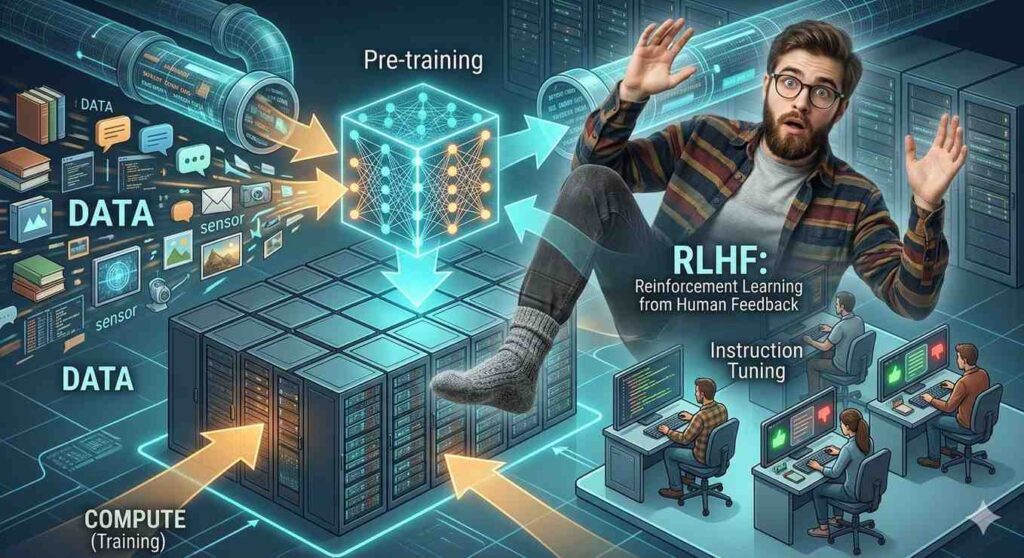
- The Three Ingredients of Every AI Model
- Where Training Data Comes From (And Who Cleans It)
- The Role of Human Labelers and Feedback
- Compute Clusters: The Physical Reality of Training
- From Random Noise to Useful Model
- Training vs Inference: Two Completely Different Phases
- Why Models Forget: Catastrophic Forgetting Explained
- The Environmental Cost of Training a Single Model
- Open Models vs Closed Models: What You Can Actually Run
- The Future of AI Training: Synthetic Data and Federated Learning
The Three Ingredients of Every AI Model
Every artificial intelligence model you interact with – whether it is a chatbot, an image generator, or a recommendation system – is built from three core ingredients. Without any one of them, training is impossible.
Ingredient One: Data – The raw examples the model learns from. For a language model, this means billions of sentences, paragraphs, and code snippets. For an image model, it means millions of labeled pictures.
Ingredient Two: Compute – The hardware that performs the mathematical operations. This is almost always graphics processing units (GPUs) or tensor processing units (TPUs). The more compute you have, the faster you can train.
Ingredient Three: Algorithms – The mathematical recipes that tell the model how to update itself based on the data. This includes backpropagation, gradient descent, and the specific architecture (like transformers).
Most public discussions focus on algorithms. But in practice, data and compute are the real bottlenecks. For a related discussion, see our AI chip demand and console price trends 2026 post.
Where Training Data Comes From (And Who Cleans It)
The internet is the primary source of training data for most large models. Companies crawl public websites, forums, academic papers, news articles, and code repositories. The dataset for a model like GPT‑4 contains roughly 13 trillion words – equivalent to reading every book ever written, thousands of times over.
However, raw internet data is incredibly dirty. It contains:
- Duplicate content (the same article posted on multiple sites)
- Spam and advertisements
- Offensive or harmful language
- Code mixed with natural language
- Incorrect statements and contradictions
Before training begins, teams spend months cleaning this data. The process includes:
- Deduplication – Removing near‑identical passages so the model does not memorize them.
- Filtering – Removing pages that are mostly ads, boilerplate, or low‑quality content.
- Language identification – Separating text by language (English, Chinese, Spanish, etc.).
- Privacy scrubbing – Removing email addresses, phone numbers, and social security numbers.
Despite these efforts, no dataset is perfectly clean. That is why models sometimes repeat verbatim phrases from their training data – a phenomenon called memorization. For more on data quality issues, see our AI overreliance consequences case studies post.
The Role of Human Labelers and Feedback
Raw data is not enough. Many AI models require labeled data – examples where a human has added the correct answer. For instance, to train a model to identify cats in photos, humans must draw boxes around thousands of cats.
This work is done by human labelers, often in countries with lower labor costs. The global market for data annotation is worth billions. Typical tasks include:
- Drawing bounding boxes around objects in images
- Transcribing audio recordings
- Classifying text as positive, negative, or neutral (sentiment analysis)
- Choosing the better of two model responses (for reinforcement learning)
After the model is trained, humans also provide feedback through systems like Reinforcement Learning from Human Feedback (RLHF). Workers rank model outputs, and those rankings are used to fine‑tune the model to be more helpful and less harmful.
The quality of human labeling directly affects model quality. Poorly labeled data trains poor models. For an inside look at how human feedback shapes AI behavior, see our sycophantic AI examples post.
Compute Clusters: The Physical Reality of Training
Training a large model requires a compute cluster – a room filled with thousands of GPUs connected by high‑speed networking. These clusters are housed in data centers that consume as much electricity as a small town.
A typical training cluster for a frontier model (e.g., GPT‑4) might include:
- 25,000 to 100,000 GPUs (mostly NVIDIA H100 or B200)
- 10 petabytes of high‑speed storage
- Liquid cooling systems to remove waste heat
- Backup power generators and redundant networking
The GPUs communicate constantly, passing gradients and activations back and forth. Even with fast interconnects, communication overhead is a major bottleneck. Engineers spend months optimizing the parallelization strategy to keep all GPUs busy.
Training runs can fail frequently. A single GPU crash can halt the entire cluster. Large‑scale training jobs use checkpointing – saving the model state every few hours – so they can resume from the last checkpoint instead of starting over. A single training run might experience dozens of hardware failures over several months.
For the impact of AI compute on hardware availability, see our how AI data centers are driving up consumer electronics prices post.
From Random Noise to Useful Model
When training begins, the model’s parameters (weights) are initialized with random numbers. It cannot do anything useful. Through training, these random numbers are slowly adjusted to become patterns.
Think of the model as a giant marble sculpture. At the start, it is a raw block of stone. Each training step chisels away a tiny amount of material. After billions of steps, the shape of the sculpture emerges.
The process is guided by a loss function – a mathematical formula that measures how wrong the model’s predictions are. The model’s goal is to minimize this loss. Each step moves the parameters slightly downhill on this loss landscape.
At the beginning, the loss drops quickly. The model learns simple patterns: common words, basic grammar, simple image features. Later, progress slows. The model learns subtle relationships, analogies, and long‑range dependencies. By the end, improvements are tiny – but they add up to the difference between a mediocre model and a state‑of‑the‑art one.
For a beginner‑friendly explanation of the underlying math, see our machine learning basics post.
Training vs Inference: Two Completely Different Phases
Most people interact with AI models during inference – when the model generates a response to a prompt. But training and inference are fundamentally different in almost every way.
| Aspect | Training | Inference |
|---|---|---|
| Direction | Updates model weights | Uses fixed weights |
| Duration | Weeks to months | Milliseconds to seconds |
| Hardware | Thousands of GPUs | One GPU or even a phone |
| Energy per run | Very high (megawatt‑hours) | Very low (watt‑seconds) |
| Cost | Millions of dollars | Pennies per query |
| Who does it | AI companies | Anyone with a model |
Once a model is trained, it can be copied and run anywhere. That is why you can download a model like Llama and run it on your laptop – the expensive training has already been done by someone else.
Training is a capital expense. Inference is an operational expense. This distinction shapes the entire AI industry. Companies that build the largest models compete on their ability to afford training. Companies that use models compete on inference efficiency.
For a practical guide to running models on consumer hardware, see our on‑device AI privacy guide post.
Why Models Forget: Catastrophic Forgetting Explained
If you train a model on new data after it has already learned something, it often forgets the old task. This is called catastrophic forgetting. It is one of the biggest unsolved problems in deep learning.
For example, suppose you train a model to identify dogs. Then you retrain it on cats. The model may become excellent at cats but completely forget what a dog looks like. The new learning overwrites the old.
Why does this happen? Neural networks share parameters across tasks. When you update the weights to improve performance on the new task, those changes can degrade performance on the old task. There is no automatic separation.
How do researchers mitigate it?
- Replay – Mix some old data with the new data during training.
- Elastic weight consolidation – Protect important weights by adding a penalty to change them.
- Multi‑task training – Train on all tasks simultaneously from the start.
Despite these methods, catastrophic forgetting remains a barrier to lifelong learning in AI. Models still cannot learn continuously like humans do. For ongoing AI limitations, see our AI delusional spiral research post.
The Environmental Cost of Training a Single Model
The energy consumption of training large models is staggering. A single training run for a model like GPT‑4 emits roughly 300 tons of carbon dioxide equivalent – the same as driving 60 gasoline‑powered cars for a full year. Multiply that by dozens of models per company, and the footprint grows quickly.
Here is a breakdown for a typical frontier model training run:
| Component | Energy (MWh) | Percentage |
|---|---|---|
| GPU compute | 40,000 | 80% |
| Cooling systems | 8,000 | 16% |
| Networking and storage | 2,000 | 4% |
| Total | 50,000 | 100% |
Fifty megawatt‑hours could power 1,700 average US homes for one day. And that is just for training. Inference across millions of users multiplies the energy cost dramatically.
Some companies are addressing this by:
- Using renewable energy for data centers
- Designing more efficient architectures (e.g., mixture of experts)
- Training once and distilling into smaller models for inference
The environmental cost is a growing concern. For a deeper look at AI energy usage, see our sustainable electronics repair post.
Open Models vs Closed Models: What You Can Actually Run
Not all AI models are equally accessible. There is a growing divide between open models (weights are publicly available) and closed models (only accessible via API).
| Aspect | Open Models | Closed Models |
|---|---|---|
| Examples | Llama, Mistral, Qwen | GPT‑4, Claude, Gemini |
| Can you download them? | Yes | No |
| Can you run them locally? | Yes (with enough RAM/VRAM) | No |
| Can you see the training data? | Often not disclosed | No |
| Can you fine‑tune them? | Yes | Limited (via API) |
| Cost to use | Free (if you have hardware) | Pay per token |
Open models are democratizing AI. With a good gaming PC, you can run a 7 billion parameter model entirely offline. This is important for privacy, censorship resistance, and low‑latency applications.
Closed models are larger, more capable, and easier to use (no hardware required). But they come with trade‑offs: your data is sent to the cloud, and you cannot inspect or modify the model.
For most hobbyists, open models are the best starting point. For production applications that need the highest quality, closed models are still ahead. For a guide to running models locally, see our local‑first AI privacy guide post.
The Future of AI Training: Synthetic Data and Federated Learning
AI training is evolving rapidly. Two trends will shape the next five years.
Synthetic data – As the internet gets filled with AI‑generated content, new models will inevitably train on that content. This is called synthetic data. It can be useful – for example, generating variations of rare examples. But it also poses a risk: model collapse. If models repeatedly train on outputs from previous models, the quality degrades. Diversity shrinks. Rare events disappear. Researchers are studying how to detect and avoid synthetic data contamination.
Federated learning – Instead of moving data to the model, federated learning moves the model to the data. Your phone trains the model locally on your personal data, then sends only the updates (not the data) back to the central server. This preserves privacy. Federated learning is already used by Google Keyboard for next‑word prediction and by Apple for Siri improvements. It will become more common as privacy regulations tighten.
These trends point to a future where AI training is less centralized, less data‑hungry, and more privacy‑preserving. For more emerging trends, see our emerging tech trends 2026 guide post.
Frequently Asked Questions
Q: How much does it cost to train a large language model?
Training GPT‑4 cost an estimated 100–200million.Smallermodelscost500,000 to $5 million.
Q: Can I train my own model for free?
You can fine‑tune a small open model on a single GPU for free (using Google Colab’s free tier). Training from scratch is not realistic.
Q: Why do companies not release their training data?
Legal risks (copyright), competitive advantage, and the presence of sensitive information (passwords, private emails scraped from the web).
Q: How long does training take for a state‑of‑the‑art model?
Three to six months for the largest models, assuming no major hardware failures.
Q: Do models ever stop learning?
Models are static after training. They do not learn from user interactions unless explicitly fine‑tuned. This is by design – you do not want your chatbot to be permanently changed by a single user’s prompt.
Q: What is the biggest unsolved problem in AI training?
Catastrophic forgetting and the high cost of human labeling are two of the biggest. Also, we lack a theory of when models will generalize vs memorize.