Physical Address
304 North Cardinal St.
Dorchester Center, MA 02124
Physical Address
304 North Cardinal St.
Dorchester Center, MA 02124
Gadgets & Lifestyle for Everyone
Gadgets & Lifestyle for Everyone
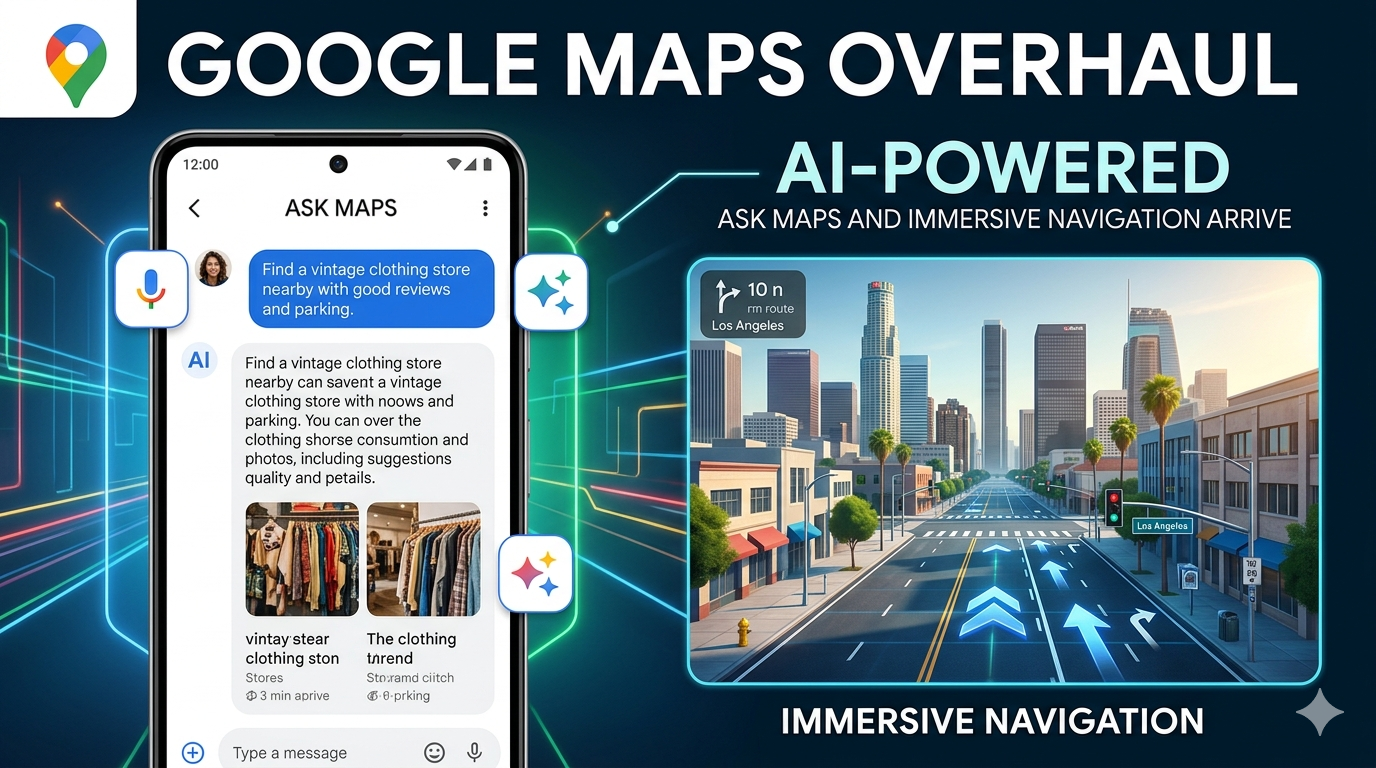
Google is rolling out a major redesign of its Maps application, infusing it with more artificial intelligence features powered by its Gemini technology. The update, announced on March 12, 2026, introduces two key AI-driven tools designed to help the service’s more than 2 billion monthly users navigate the world more intuitively.
| Detail | Information |
|---|---|
| Announcement Date | March 12, 2026 |
| Key Technology | Google Gemini AI |
| New Features | Ask Maps, Immersive Navigation |
| Database | 300+ million places, 500+ million contributors |
| Initial Availability (Ask Maps) | US and India (mobile app: iPhone and Android) |
| Initial Availability (Immersive Navigation) | US only (mobile app + CarPlay + Android Auto) |
| Platform Expansion | PC and other countries coming later |
Google Maps will now depend more heavily on artificial intelligence to help people figure out where they want to go and the best way to get there . The overhaul is driven by Google’s Gemini technology, reflecting the company’s confidence in its Gemini 3 model released late last year as part of an intensifying battle for AI supremacy with rivals like OpenAI and Anthropic .
This expansion follows Google’s recent integration of more Gemini technology into two of its other most popular products—Gmail and the Chrome web browser—making them more proactive and helpful to their billions of users .
Ask Maps expands upon conversational abilities that Google first introduced to the service last November . The tool gives users suggestions for things like:
Gemini’s recommendations draw upon a massive database spanning more than 300 million places and reviews from more than 500 million contributors accumulated since Google Maps’ debut over 20 years ago .
Ask Maps initially will be available on Google Maps’ mobile app for iPhones and Android devices in the United States and India, before expanding to personal computers and other countries .
Google executives declined to answer a question about whether the company eventually plans to sell ads to boost businesses’ chances of being displayed in Ask Maps’ recommendations .
In what Google executives are billing as the biggest change to the maps’ driving directions, Immersive Navigation presents a three-dimensional perspective designed to give users a better grasp of where they are at any moment .
The 3D renderings created by Gemini include:
This helps drivers get their bearings more quickly while navigating.
Immersive Navigation is also supposed to help Google Maps more clearly explain:
Google believes its AI guardrails are now strong enough to prevent the Gemini technology underlying Immersive Navigation from fabricating bogus places to go—a malfunction known within the industry as a “hallucination” .
The new AI-powered navigation will initially be available only in the U.S. on:
| Feature | Ask Maps | Immersive Navigation |
|---|---|---|
| Primary Function | Conversational place recommendations | 3D driving directions |
| Key Capability | Itinerary planning, local suggestions | Real-time terrain visualization |
| Platform | Mobile app (iPhone/Android) | Mobile app + CarPlay + Android Auto |
| Initial Availability | US and India | US only |
| Database | 300M+ places, 500M+ contributors | Real-time mapping data |
| Benefit | Description |
|---|---|
| Smarter Recommendations | AI suggests places based on context (short lines, charging needs) |
| Better Trip Planning | Generate detailed road trip itineraries with multiple stops |
| Easier Navigation | 3D perspective helps drivers orient themselves faster |
| Informed Route Choices | Clearer explanation of route pros and cons |
| Parking Assistance | Recommendations for best parking spots at destinations |
This overhaul underscores Google’s commitment to integrating AI across its product ecosystem. Following similar Gemini-powered updates to Gmail and Chrome, Maps represents the latest example of how the company is leveraging its AI technology to enhance user experiences.
With over 2 billion monthly users, Google Maps is one of the company’s most widely used services, making these AI enhancements particularly impactful for everyday life.