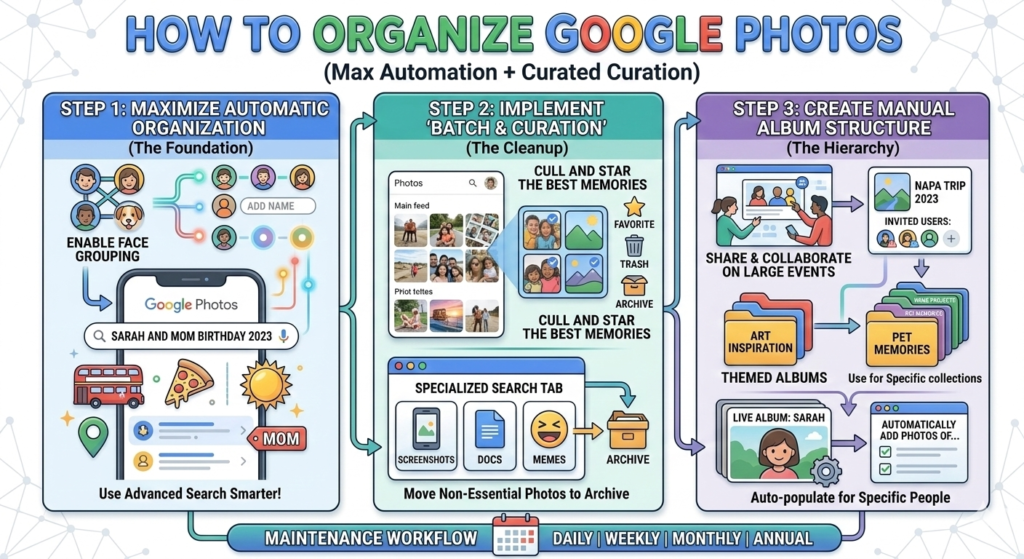
A messy Google Photos library can make finding your favorite memories feel like searching for a needle in a haystack. Fortunately, Google has rolled out powerful new tools that put you in control. This guide covers everything from smart AI features to manual organization tricks.
Why Organize Google Photos?
| Benefit | What It Means |
|---|---|
| Find photos instantly | Stop scrolling endlessly—search by face, place, or object |
| Save storage space | Remove duplicates, blurry shots, and unwanted screenshots |
| Enjoy memories | See curated highlights without the clutter |
| Share easily | Create clean albums for family and friends |
Step 1: Enable Backup (Essential First Step)
Before organizing, ensure all your photos are safely backed up .
- Open Google Photos
- Tap your profile picture or avatar
- Select Photos settings > Backup
- Turn on Backup
- Choose upload quality:
- Original quality (counts against your storage)
- Storage saver (high quality, uses less space)
Once backup is active, use “Free up space” to remove local copies from your device .
Step 2: Master AI-Powered Organization
Google Photos does much of the heavy lifting automatically. Here’s how to make the most of it.
Face Grouping (People & Pets)
Enable face grouping to automatically sort photos by the people and animals in them .
- Go to Photos settings > Preferences
- Tap Group similar faces
- Toggle it on
To name faces:
Google now also identifies pets automatically—no more endless scrolling for dog photos .
Smart Search
The search bar is incredibly powerful. Just type what you’re looking for :
- “Beach” (finds all beach photos)
- “Alice and me smiling” (natural language works)
- “April 2025” (by date)
- “Pizza” (finds food photos)
- “San Francisco” (by location)
The AI recognizes objects, scenes, text inside images, and even specific people once you’ve named them .
Step 3: Use Photo Stacks to Reduce Clutter
Photo stacks are one of the most useful organization features. They group similar photos taken around the same time into a single thumbnail, saving precious screen space .
Automatic Stacking
Google automatically identifies and stacks images it considers similar. Tap any stacked photo to expand and see all images inside .
Manual Stacking (New Feature!)
The latest update lets you create stacks manually—a game-changer for control freaks .
On iOS (currently available):
Note: This feature is rolling out first on iOS and should reach Android and web soon .
Why this matters: You can now group any photos you want, even if Google didn’t automatically stack them. Perfect for events, outings, or just keeping your feed tidy .
Step 4: Create Smart Albums
Albums are the classic way to organize, but Google makes them dynamic.
Create a Standard Album
- Tap the + (plus) button
- Select Album
- Add a title and description
- Choose photos or let AI suggest them
Create an Auto-Update Album
This is where Google Photos shines. You can create albums that automatically add new photos of specific people or things .
- When creating an album, select “Auto-add photos”
- Choose faces or objects to include
- Turn on notifications so you know when new photos appear
Example: Create an album for your child, and every new photo of them will automatically appear there.
Create Albums from Search
- Use the Search tab to find photos (e.g., “Food”)
- Long-press to select multiple images
- Tap + > Album
- Name and save
Step 5: Organize Documents Automatically
Google Photos now automatically sorts your documents into smart albums .
Find Document Albums
You’ll see categories like:
- ID cards
- Receipts
- Notes
- Event information
Auto-Archive Old Documents
To keep your main feed clean, enable auto-archiving :
- In Collections > Documents, tap a category
- Toggle on Archive after 30 days
Photos older than 30 days will move out of your main view but remain accessible in Collections.
Change Document Categories
If Google miscategorizes a document, you can fix it :
On iPhone/iPad:
- Go to Albums > Documents
- Open the image
- Tap the category at the top
- Select Change categories and pick the right one
- Tap OK
On Web:
- Open Google Photos > Documents
- Click an image
- Click the category name (top left)
- Select Change and choose a new category
Step 6: Hide Clutter and Sensitive Items
Hide App Clutter
Tired of seeing memes, screenshots, and random app images?
- In Photos, tap the three-dot menu
- Select Hide clutter from other apps
This hides photos from non-camera apps, giving you a cleaner camera roll.
Use Locked Folder for Private Photos
The Locked Folder keeps sensitive photos hidden behind your screen lock .
To set it up:
- Go to Collections > Locked Folder
- Tap Set up
- Authenticate with PIN, pattern, or fingerprint
- Tap Move items to add photos
These photos won’t appear in your main feed, memories, or shared albums. You can choose to back them up (making them accessible across devices) or keep them only on your current device .
Step 7: Maintain Your Library Regularly
Organization isn’t a one-time task. Here’s how to stay on top of it.
Use Files by Google for Bulk Cleanup
The Files by Google app intelligently suggests items to delete :
- Duplicate files
- Blurry photos
- Old screenshots
- Unused apps
Monthly Maintenance Routine
| Task | Frequency |
|---|---|
| Review and delete screenshots | Weekly |
| Check “Stack similar photos” accuracy | Monthly |
| Create albums for recent events | After each trip/event |
| Empty trash (items stay 60 days) | Monthly |
| Review document categories | Quarterly |
Step 8: Use Search for Quick Access
Sometimes organization means finding what you need fast. Google Photos search is incredibly powerful .
Try searches like:
- “Birthday party 2025”
- “My dog playing”
- “Receipts from March”
- “Screenshots of addresses”
The new “Ask Photos” feature (powered by Gemini AI) will soon let you ask complex questions like “Show me photos of Alice and me at the beach last summer” .
Quick Reference Card
| Task | Action |
|---|---|
| Enable backup | Profile → Photos settings → Backup |
| Stack similar photos | Three-dot menu → Stack similar photos |
| Create manual stack | Select photos → Stack photos |
| Name faces | Search tab → Face → Assign name |
| Create album | + → Album → Add photos |
| Find documents | Collections → Documents |
| Hide clutter | Three-dot menu → Hide clutter from apps |
| Lock private photos | Collections → Locked Folder → Move items |
Final Checklist
✅ Backup enabled (with preferred quality)
✅ Face grouping turned on
✅ Similar photos stacking activated
✅ Key people named in Search
✅ Document albums reviewed
✅ Locked Folder set up for private items
✅ Clutter hidden from other apps
✅ Trash emptied (optional)
✅ Auto-archive configured for old documents
Final Verdict
Google Photos in 2026 offers more organization power than ever. The combination of AI automation and manual controls—especially the new manual stacking—lets you create a library that’s both tidy and deeply personal .
Start with the basics: enable backup, turn on face grouping, and activate photo stacking. Then gradually explore albums, document organization, and the Locked Folder. With regular maintenance, you’ll never lose a memory again.